Qingyan Ancient Town from Guiyang: The Half-Day Guide (Tickets, Getting There, What to Eat)
Qingyan Ancient Town from Guiyang in a half day: metro Line 3 plus bus, Didi costs, the 10 vs 60 RMB ticket, a 4-5 hour route through the four gates, and the trotters and rose sugar to order.
Qingyan is the trip I get asked about most from anyone using Guiyang as a base, and the one Guiyang excursion I have somehow never done properly myself, despite my mum being from the city and the town sitting 29 km down the road. So this is not a memoir. It is the logistics post I wanted to hand people, built from Chinese-language guides updated for 2026, recent English reviews, official ticket and bus data, and enough Guiyang context to know which bits matter.
The short version: Qingyan is a 600-year-old Ming garrison town built of grey stone, ringed by a walkable wall, with four gates, a Qing-dynasty top scholar's mansion, and the best pig's trotters in the province. It is also, by most recent accounts, the busiest and most commercial of Guizhou's ancient towns. The way to get the good version is to time it right, buy the right ticket, and eat properly. For how it ranks against the bigger excursions, the day trips from Guiyang post has the full list.
Is Qingyan worth it?
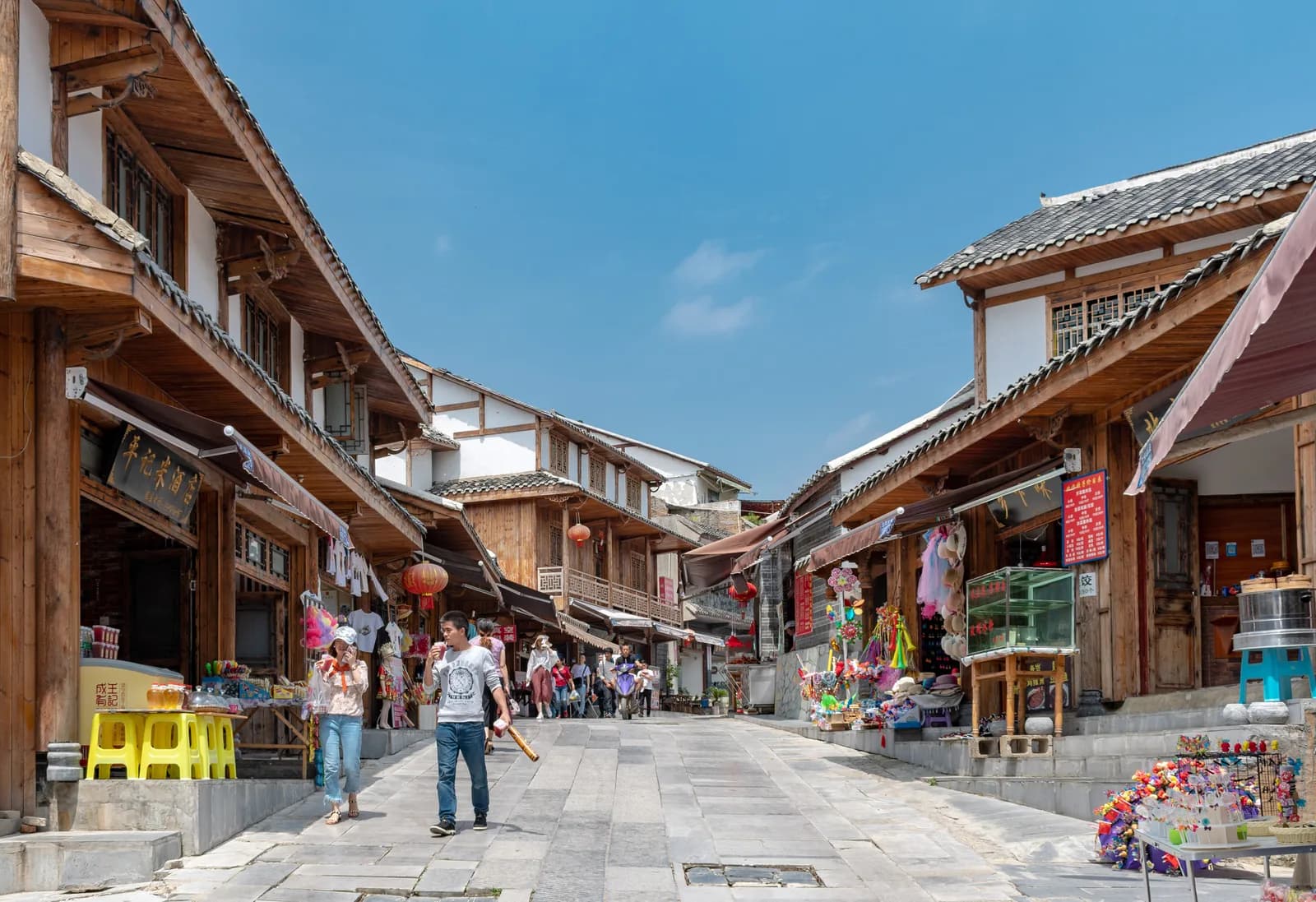
Yes, with the expectation set correctly. Qingyan was founded in 1378 as a military outpost guarding the road south of Guiyang, and the stone walls, gate towers and bluestone lanes are the original point. It became Guiyang's first 5A scenic area in 2017 and was the backdrop for Lu Chuan's 2002 film The Missing Gun. What makes it unusual for a small Chinese town is the religious mix: Buddhist and Taoist temples, a Catholic church and a Protestant church inside the same square kilometre.
The honest half comes from recent visitors. A May 2026 Tripadvisor review called it "probably the most crowded and touristy of all the ancient towns" the writer had seen in southern China, then said climbing the wall was the highlight because almost nobody else did. A November 2025 review called the wall "remarkable" and the RMB 10 entry surprisingly cheap; a February 2025 visitor found more real history inside the mansions than expected. That is the consensus: the main streets are a snack-and-souvenir strip, the wall and the back alleys are the reason to come, and you will see very few other foreigners.
Guiyang to Qingyan: every way to get there
Qingyan sits in Huaxi District about 29 km south of the centre, and there are more ways to reach it than the English guides admit. Costs below are from the 2025-2026 guides I checked.
| Option | Route | Time | Cost (RMB) | Best for |
|---|---|---|---|---|
| Metro + bus | Line 3 to Tongmuling (terminus), exit D, bus 210 or Huaxi bus 18 to North Gate | 60-75 min from centre | 5-8 | Cheapest, no booking |
| Bus 203 | Guiyang Railway Station direct, 39 stops to North Gate | 70-90 min | 2-5 | Staying near the old station |
| Bus 210 | Huaguoyuan direct, 28 stops | 60-80 min | 2-5 | Staying in south Nanming |
| Tourist line | Guiyang North Station or Guiyang Railway Station, hourly | ~40-60 min | 10-20 | Arriving by high-speed rail |
| Didi | Door to South Gate or North Gate | 40-60 min | 60-80 | Groups, early starts |
| Tour | Hotel pickup, guide, entry | Half day | 100-180 pp | No-hassle option |
The metro move is the one I would do. Line 3 runs through the centre to Tongmuling, its southern terminus; leave by exit D and bus 210 takes about 15 minutes to the North Gate for RMB 2 (the Huaxi 18 bus covers the same leg). Transit QR code or exact coins only. It costs about the price of a coffee and dodges the Huaxi Avenue traffic that stretches a Didi to an hour on weekends.
The direct buses (203 from Guiyang Railway Station, 210 from Huaguoyuan) work but are slow, about an hour with the last return around 9pm. Hourly tourist coaches also run from Guiyang North Station and Guiyang Railway Station to the tourist centre by the North Gate: RMB 10-20, departures from about 8am or 9am, last return around 7pm. Straight off a high-speed train, this is the simplest option.
Didi is what most foreign reviewers actually use: RMB 60-80 one way from Nanming or Yunyan, about 40 minutes off-peak, and the only way to reach the South Gate before 9am. For an organised version, a Qingyan Ancient Town half-day tour on Klook bundles the driver and the through-ticket for around RMB 100-180.
Qingyan tickets: what RMB 10 and RMB 60 actually buy
There are two products, and the English guides tend to only name one. Current prices from the 2025-2026 Chinese guides:
| Ticket | Price (RMB) | What it covers | Worth it? |
|---|---|---|---|
| Main ticket | 10 | Streets, back alleys, climb onto the Dingguang Gate section of the wall | Yes, always |
| Through-ticket | 60 | Everything above plus the ten-plus ticketed sights inside | Yes if you have 4+ hours |
| After ~5:30pm | Free | Streets and lanes only; indoor sights closed | Sunset and dinner only |
| Sightseeing cart | 20 | North Gate shuttle to the centre | Skip; it is a 15-minute walk |
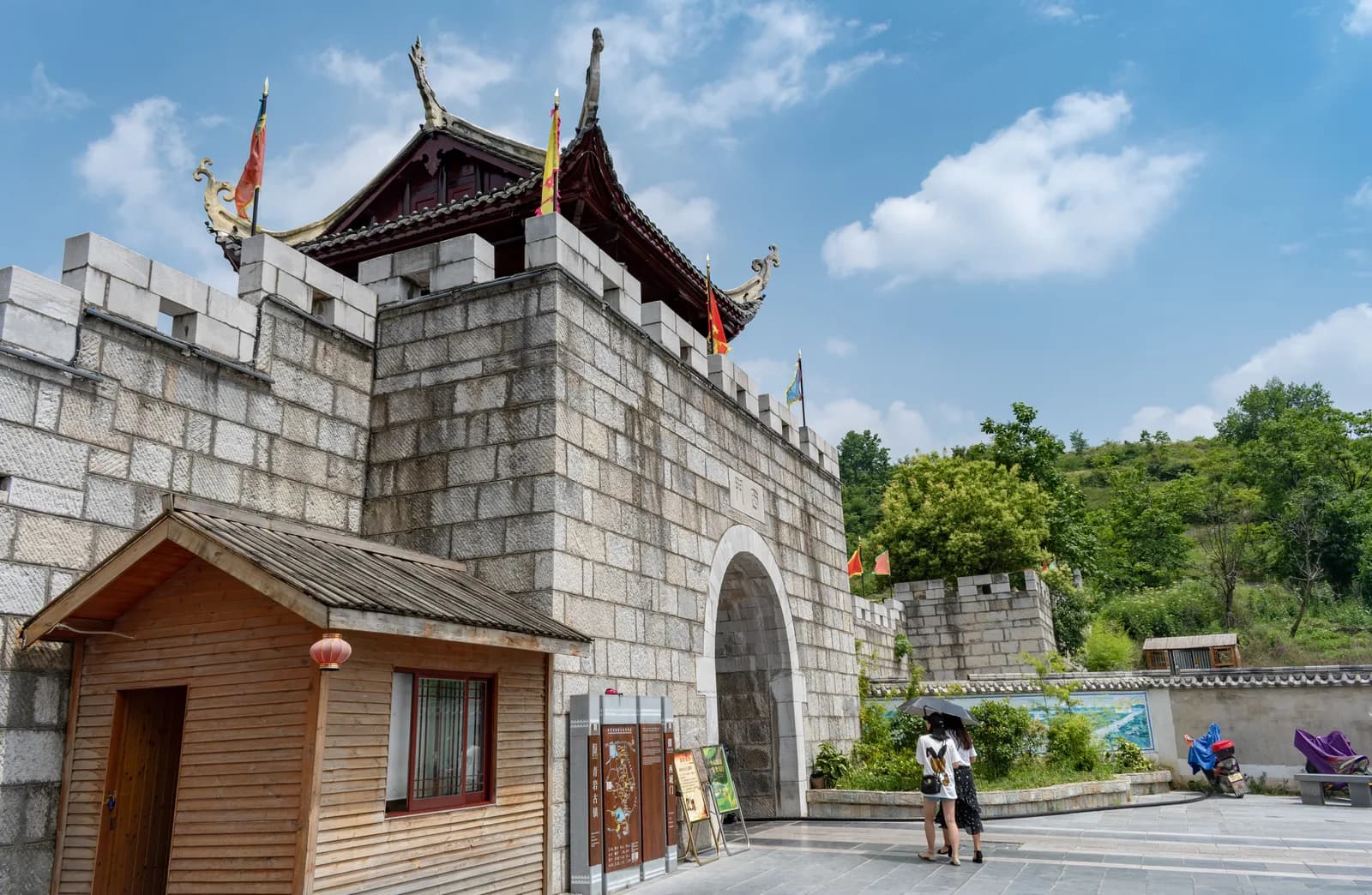
The RMB 10 main ticket is the bargain in Guizhou, because it includes the wall. Dingguang Gate is the big southern gate, and the ridge section running from it is the stretch every recent review singles out: a tough climb, the best views in town, and the 2026 Chinese guides all recommend it for sunset. The circuit runs about 2 km along the hills on stone steps, and the crowds thin the moment you leave the flat streets.
The RMB 60 through-ticket is the one to buy for a proper half day, because the sights behind it are the actual history. The headline is Zhuangyuan Mansion, the courtyard home of Zhao Yijiong, who in 1886 became the first person from Guizhou to top the imperial exam; the town has built its identity around him, which is why the trotters carry his title. The ticket also covers Ciyun Temple, Wanshou Palace (the old Jiangxi merchants' guild hall), Longquan Temple, Wenchang Pavilion, the Zhao ancestral hall, Shoufo Temple, and the small house where Zhou Enlai's father lived in hiding during the war.
Two footnotes. The ticketed sights keep roughly 8:30am to 5pm hours, while the streets stay open into the evening and go free after about 5:30pm. Under-14s and over-70s are free, 60-70 is half price, and students get half price with ID. Some older English pages quote an RMB 80 through-ticket; every 2025-2026 source I found says RMB 60.
The 4-5 hour route through the four gates
The town has gates at the north, south, east and west, and the main street runs roughly 1.3 km from the North Gate to the South Gate. The mistake is to enter at the North Gate, walk the main street, and leave thinking that was Qingyan. The route the 2026 Chinese guides push, and the one I would follow, is south to north.
Hour one: South Gate and the wall. Get dropped at the South Gate (Dingguang Gate); it is the quieter entrance and the wall starts right there. Buy the through-ticket, climb the gate tower, and walk the ridge section while your legs are fresh. In the morning you will mostly have it to yourself.
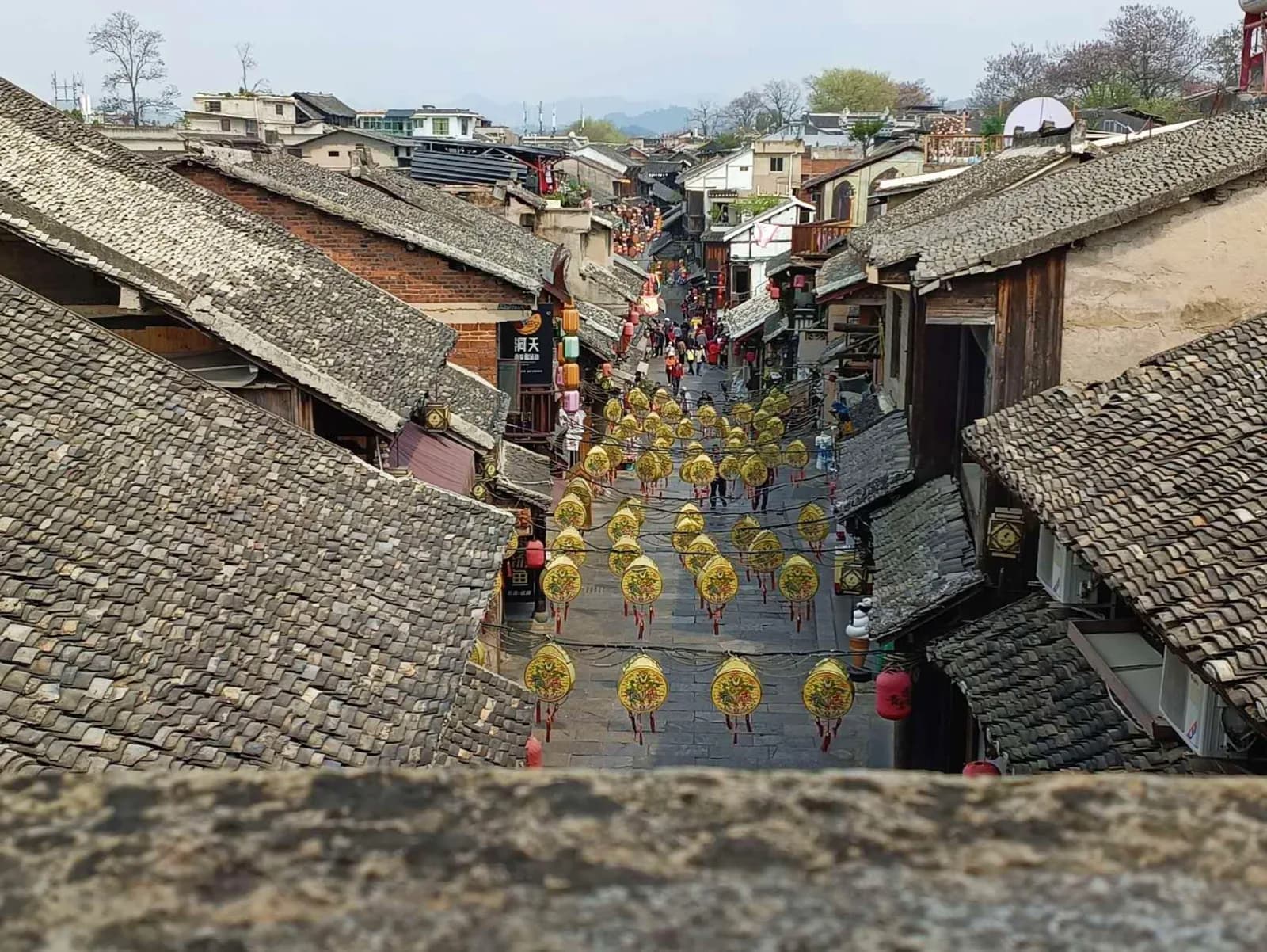
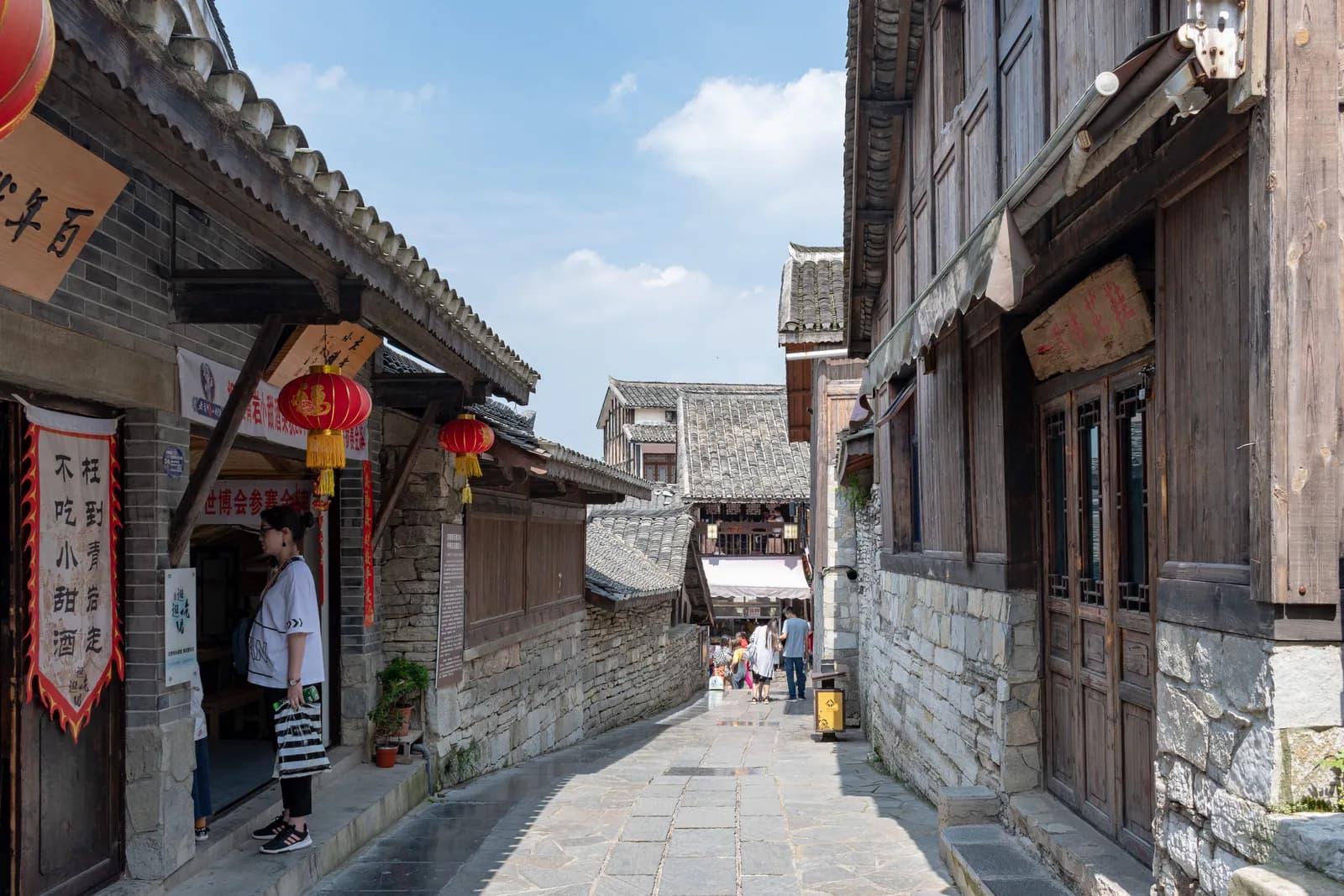
Hour two: the archway and the back alleys. Come down under the Zhao Lilun Baishou archway, the carved stone gate raised in the 1800s for a local centenarian, then turn off the main drag into the back street (beijie), the lane of high mortarless stone walls and worn bluestone that every Chinese guide recommends for photos and that was used in The Missing Gun.
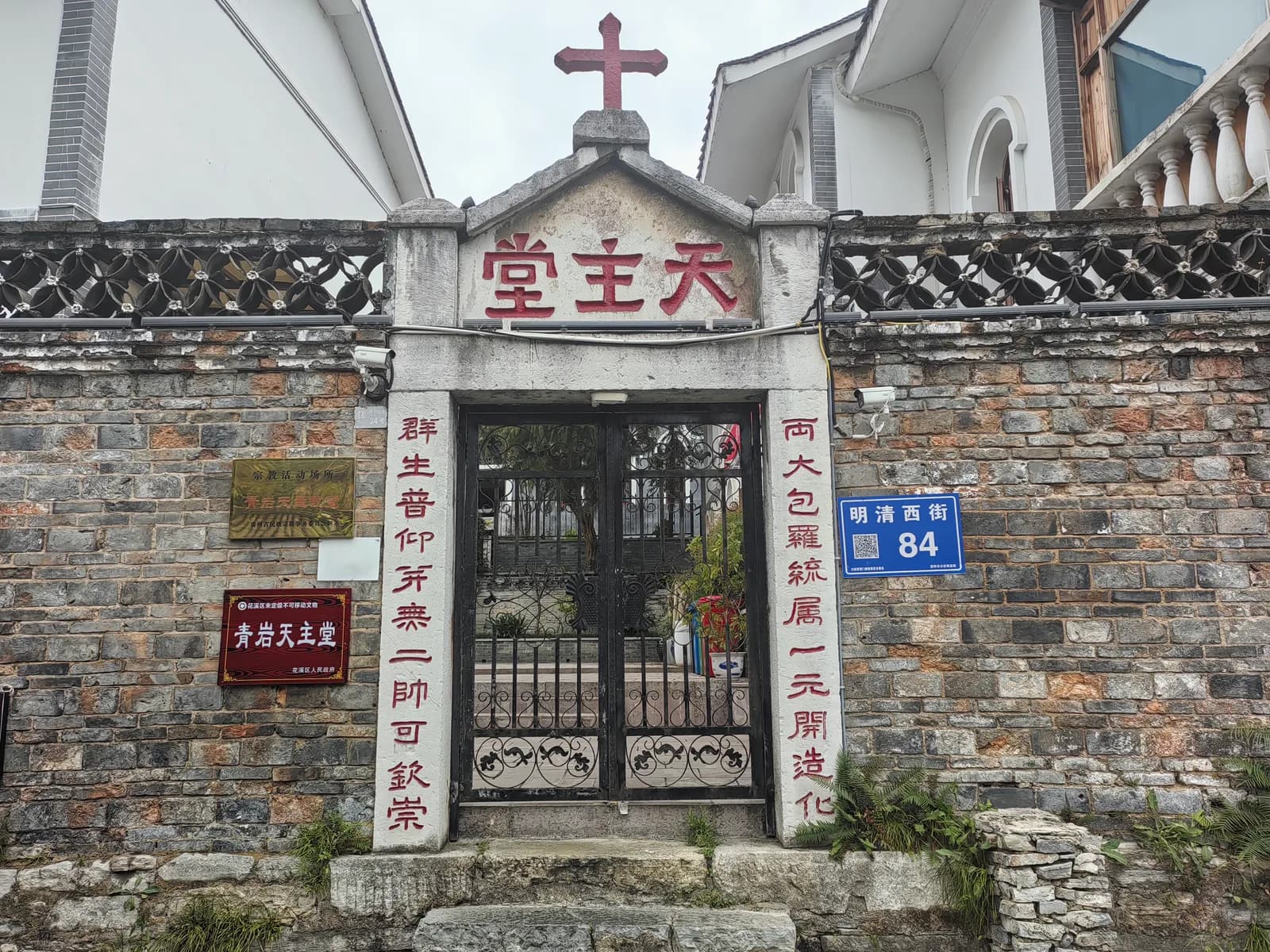
Hour three: the through-ticket sights. Work up through the centre: Zhuangyuan Mansion first, then Ciyun Temple and Wanshou Palace, which sit close together. Pick two or three rather than all ten; the smaller halls repeat themselves. Then cut west to West Street for the Catholic church, a stone-fronted building from the mid-1800s that is one of the more surprising things to find in a Ming garrison town.
Hours four and five: lunch on the Ming-Qing street, then out the North Gate. The main street between the centre and the North Gate is the food strip. Eat (next section), pick up rose sugar for the trip home, and exit at the North Gate, where bus 210 and the tourist coaches wait. If you are pairing Qingyan with Tianhetan, flip the day: nature site in the morning, Qingyan from about 3pm, the wall at sunset, dinner on the free evening streets. The things to do in Guiyang post has the in-city half of that plan.
Wear grippy shoes. Every recent review mentions the polished bluestone, and a November 2025 visitor flagged the stairs as a real problem for anyone with mobility issues.
What to eat in Qingyan
Qingyan is a food town first, with its own dishes rather than just the Guiyang canon. The Chinese guides' "four-piece set" is trotters, rose sugar, rice-cake porridge and tofu balls.
Zhuangyuan trotters (zhuangyuan ti) are the signature: pig's trotters braised for hours in a spiced soy stock until the skin turns glossy and the meat falls off, named for the legend that Zhao Yijiong ate them before his exam. Every second shop sells them, but two names come up in nearly every guide, both on the main street. Wang Wanma is the small, cheap, queue-out-the-door one that appeared on A Bite of China; Jinbixuan is the bigger, slightly pricier shop with fast turnover. Expect around RMB 30-35 a plate, eaten fresh at a table; the 2026 guides warn the vacuum-packed version is a different, worse product.
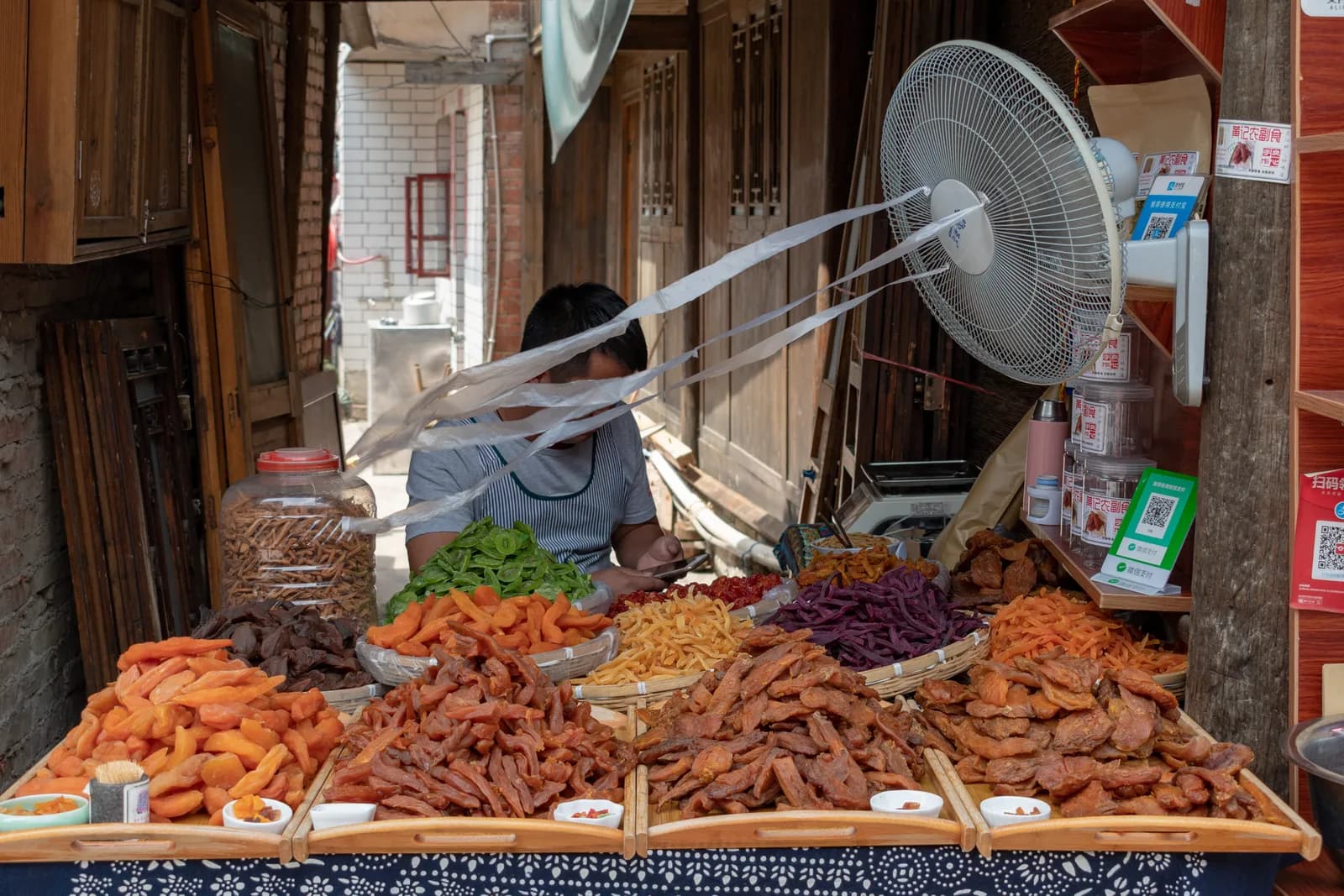
Rose sugar (meigui tang) is the sweet the town is known for across Guizhou: a hard candy and a rose jam made from local roses, sold by the box. It shows up again on gaoba rice-cake porridge (gaoba xifan), lotus-root starch thickened into a warm gel with a steamed rice cake dropped in, finished with sesame, peanuts, preserved fruit and rose syrup; the Xiejia shop is named in the 2026 Trip.com guide at about RMB 8 a bowl. Rose jam also tops the ice jelly (bingfen), the cold dessert for summer.
Tofu balls (doufu yuanzi), crisp outside and soft inside, run about RMB 5 for four, and Qingyan's rice tofu (mi doufu) is green rather than the yellow Guiyang version, served cold in chili oil. The Guiyang Bites blog goes deep on the town's wider tofu subculture: puffed tofu in chicken broth, fermented tofu rolled in chili, smoked firm tofu. Jila jiao, the local chicken-and-chili paste, is the edible souvenir.
For a sit-down meal, sour soup fish is on every proper restaurant menu, and this is a fine place for your first one before the full version in the city. The Guiyang food guide covers that dish and the sour-versus-numbing distinction that makes Guizhou food its own thing.
Best time of day, and the holiday problem
Timing decides whether Qingyan feels like a stone town or a shopping mall. The 2026 Chinese guides and the recent English reviews agree on the windows.
Before 9am is the quiet version. Tour groups arrive from about 10am, and from late morning to mid afternoon on weekends the main street is shoulder to shoulder. Didi down for an 8:30am start at the South Gate and you get the wall and the back street nearly empty.
After 4pm is the second window and arguably the better one: the crowds drain, sunset from Dingguang Gate is the photograph the Chinese guides push, and the streets go free after about 5:30pm. The trade-off is that the through-ticket sights close around 5pm, so for the mansion and the temples, arrive by 3pm.
Public holidays are a hard no. Over the combined National Day and Mid-Autumn holiday in October 2025 (October 1 to 8) the town recorded 375,200 visitors and required online reservations just to get in; Spring Festival and May Day are the same story. A Tuesday in April or October is a completely different place. The seasonal logic matches the rest of the province, which the Guizhou itinerary lays out: spring and autumn for weather, avoid the three national holidays.
Qingyan vs Zhenyuan vs Huangguoshu for a short window
The question behind "is Qingyan worth it" is usually "should I spend my one spare day here or somewhere else." Here is how it stacks up against the usual alternatives, plus Tianhetan, its natural half-day partner.
| Qingyan | Tianhetan | Huangguoshu | Zhenyuan | |
|---|---|---|---|---|
| Distance from Guiyang | 29 km | ~35 km | ~130 km | ~270 km |
| Time needed | Half day | Half day | Full day | Overnight |
| Getting there | Metro + bus, or Didi RMB 60-80 | Metro S1 or Didi | HSR to Anshun + shuttle | 4 hr train |
| Entry | RMB 10 / 60 | Under RMB 100 combo | RMB 160 + 50 shuttle | Free town, RMB 60 cave |
| Crowds | Heavy on weekends | Moderate | Heavy on weekends | Light |
| Verdict | Best half day | Best pairing with Qingyan | Best full day | Best ancient town |
The logic is simple. With half a day, Qingyan is the only one of these you can actually do, and it is a good one. With a full day, Huangguoshu is the bigger experience and the one nobody regrets, with the logistics in the day trips from Guiyang post. If what you want is a quiet old town where locals still run the shops, Zhenyuan beats Qingyan on atmosphere by every recent account, but it costs a night in eastern Guizhou; the Zhenyuan guide covers that trade. For pure nature, Libo Xiaoqikong is the overnight to add.
My call for a three-day Guiyang stay: day one in the city, day two Huangguoshu, day three Tianhetan in the morning and Qingyan from mid afternoon through sunset and dinner.
Where to stay for a Qingyan half day
Qingyan is close enough that your Guiyang base matters more than anything in the town. The full zone-by-zone comparison is in the where to stay in Guiyang guide; this is the Qingyan cut.
Stay in Nanming if this is your first Guiyang trip: the old riverside core, the densest food streets, and a direct Line 3 ride south to Tongmuling. Pick Huaxi if Qingyan and Tianhetan are the priority and you want a cheaper, quieter university-district base 20 minutes from the South Gate, accepting a longer commute to the city sights. Choose Guanshanhu if you arrive by high-speed rail and want the Hilton-and-Hyatt tier next to Guiyang North, where the hourly tourist coach to Qingyan leaves from.
The fourth option is to stay in Qingyan itself for a night. A handful of guesthouses sit inside and just outside the walls, and the payoff is the version of the town almost nobody sees: the free evening streets after the coaches leave, and the wall at 8am before they return. Trip.com tends to list more of the small local inns than Booking does, so check both.
Recommendations
- Take metro Line 3 to Tongmuling and bus 210 out; Didi back if you stay for sunset, since the buses thin out after 7pm.
- Enter at the South Gate, not the North, so you climb the wall first and finish on the food street.
- Buy the RMB 60 through-ticket if you have four hours, the RMB 10 ticket if you have two.
- Aim for before 9am or after 4pm, and avoid every Chinese public holiday without exception.
- Eat trotters at Wang Wanma or Jinbixuan, fresh at a table, and skip the vacuum packs.
- Order the rice-cake porridge and a box of rose sugar; neither is done properly in the city.
- Ignore the touts offering "fast-track" tickets and the RMB 20 sightseeing cart at the North Gate; the town is a 15-minute walk end to end.
- Wear shoes with grip. The bluestone is polished smooth and the wall steps are steep.
- Set up Alipay or WeChat Pay before you go; the stalls and the RMB 2 bus are effectively cashless.
- Pair it with Tianhetan on the same day and save your full days for Huangguoshu.
Final note
I will update this once I have walked the wall myself; it is overdue. But the record is clear enough to plan from. Qingyan is neither the quiet stone village the brochures sell nor the tourist trap the grumpier reviews describe. It is a busy, well-run, 600-year-old garrison town with a cheap ticket, a real wall and some of the best eating in Guizhou, and the difference between a great half day and a frustrating one is arriving at the South Gate at 8:30am on a weekday with an appetite.
If you have been recently and a price or a bus route has moved, tell me and I will fix it. For the rest of the trip, the first impressions of Guiyang post covers the city on arrival, the Captain George coffee review is where to recover the next morning, and if you are heading east, the Fanjingshan guide for foreign visitors handles the mountain that needs the most advance planning in the province.
Frequently asked
How do you get from Guiyang to Qingyan Ancient Town?
The cheapest way is metro Line 3 to its southern terminus at Tongmuling, then bus 210 (or the Huaxi 18 bus) for about 15 minutes to the North Gate, roughly RMB 5-8 all in. Bus 203 from Guiyang Railway Station and bus 210 from Huaguoyuan run direct but take over an hour. A Didi from central Guiyang is about RMB 60-80 and 40-60 minutes depending on traffic, which is the option most recent foreign visitors end up using.
How much are Qingyan Ancient Town tickets?
There are two tiers. The RMB 10 main ticket covers the streets, the back alleys and the climb onto the Dingguang Gate section of the city wall. The RMB 60 through-ticket adds the ten-plus ticketed sights inside: Zhuangyuan Mansion, Ciyun Temple, Wanshou Palace, Longquan Temple, Wenchang Pavilion, the Zhao ancestral hall and the house where Zhou Enlai's father lived. After about 5:30pm the streets are free, but the indoor sights are closed by then.
Is Qingyan Ancient Town worth visiting?
Yes, as a half day. Recent visitors are consistent that the main streets are commercial and crowded, but the Ming city wall, the stone back alleys and the food still make it the best short trip out of Guiyang. It is a 40-60 minute run from the centre with a RMB 10 entry, so the cost of finding out is low. Do not expect the calm of Zhenyuan; expect a well-run, busy, edible stone town.
How long do you need at Qingyan Ancient Town?
Four to five hours covers it properly: the wall, the back alleys, two or three of the through-ticket sights and a long lunch. Trip.com's listing suggests 2-3 hours, which is enough for the RMB 10 version of the visit. Add travel and it fills a half day from Guiyang, which is why the natural pairing is Tianhetan or Huaxi Park in the other half.
What food is Qingyan Ancient Town famous for?
Zhuangyuan pig's trotters (braised trotters named after the town's Qing-dynasty top scholar), rose sugar, gaoba rice-cake porridge, tofu balls and Qingyan's green rice tofu. The two trotter shops that come up in nearly every Chinese guide are Wang Wanma and Jinbixuan on the main street, with a plate of trotters around RMB 30-35. Sour soup fish is available at the sit-down restaurants if you want a full meal.
When is the best time of day to visit Qingyan?
Before 9am or after 4pm. Tour groups arrive from about 10am and the main streets are at their worst from late morning to mid afternoon on weekends. Late afternoon puts you on the Dingguang Gate wall for sunset, and the streets go free after roughly 5:30pm. Avoid Chinese public holidays outright: over the October 2025 National Day week the town took 375,000 visitors in eight days and required online reservations.
Is Qingyan better than Zhenyuan or Huangguoshu?
For a half day, Qingyan wins by default because it is the only one of the three you can do in that window. Huangguoshu is a full day (30 minutes by high-speed rail to Anshun plus a shuttle) and Zhenyuan is an overnight, four hours east. If you have a full day, Huangguoshu is the bigger payoff. If you want a quiet river town, Zhenyuan is the better ancient town, but it costs you a night.