First Impressions of Guiyang, China (Visiting My Mum's Hometown)
First impressions of Guiyang, China, as a Kiwi visiting my mum's hometown: what surprised me, what I got wrong, and what I'd do differently next time.
China Has the Best Coffee in the World and Nobody Is Talking About It
Guiyang is my mum's hometown. I'd grown up hearing about it as one of China's poorer provincial capitals, the kind of place that didn't make it onto travel lists. On my first afternoon there, walking solo because Kaid had a fever the night before and was stuck recovering at the hotel, I crossed under an elevated pedestrian walkway in Yunyan and counted three Shiba Inu prints on three different shopfronts in twenty metres. The city my mum grew up in was not this city.
It was an "American-inspired" mall strip with outdoor camping chairs at the cafes, a coffee shop on the corner that had just won a world championship, and a 60-minute wait for a single drink. I stood there with a five-dollar cold brew in my hand and tried to reconcile the version I'd been told about (small, poor, mountain-locked) with the version I was walking through. Here's everything that surprised me about Guiyang on a 48-hour solo loop, and what I'd want a Kiwi friend to know before they came expecting the city in the old story.
The Guiyang my mum talked about isn't the dominant story anymore
Guiyang sits at around 1,070 m elevation in the karst-mountain heart of Guizhou province. For most of the late 20th century, it was widely regarded as one of China's poorer provincial capitals, the kind of place that featured in domestic development plans more than in tourist itineraries. That version is still in the foundation of the city, but it's no longer the dominant story.
In the last decade, Guiyang's been hit hard with two pivots: a massive high-speed rail buildout (Guiyang North station opened in 2014, connecting the city to Beijing, Shanghai, Guangzhou, and Chengdu), and an explicit positioning as a big-data and tech hub for southwest China. Layer on top of that a specialty-coffee boom that culminated in a Guiyang barista (Peng Jinyang of Captain George Coffee) winning the 2025 World Brewers Cup, and you have a city that's effectively rebranded itself in the time my mum's been overseas.
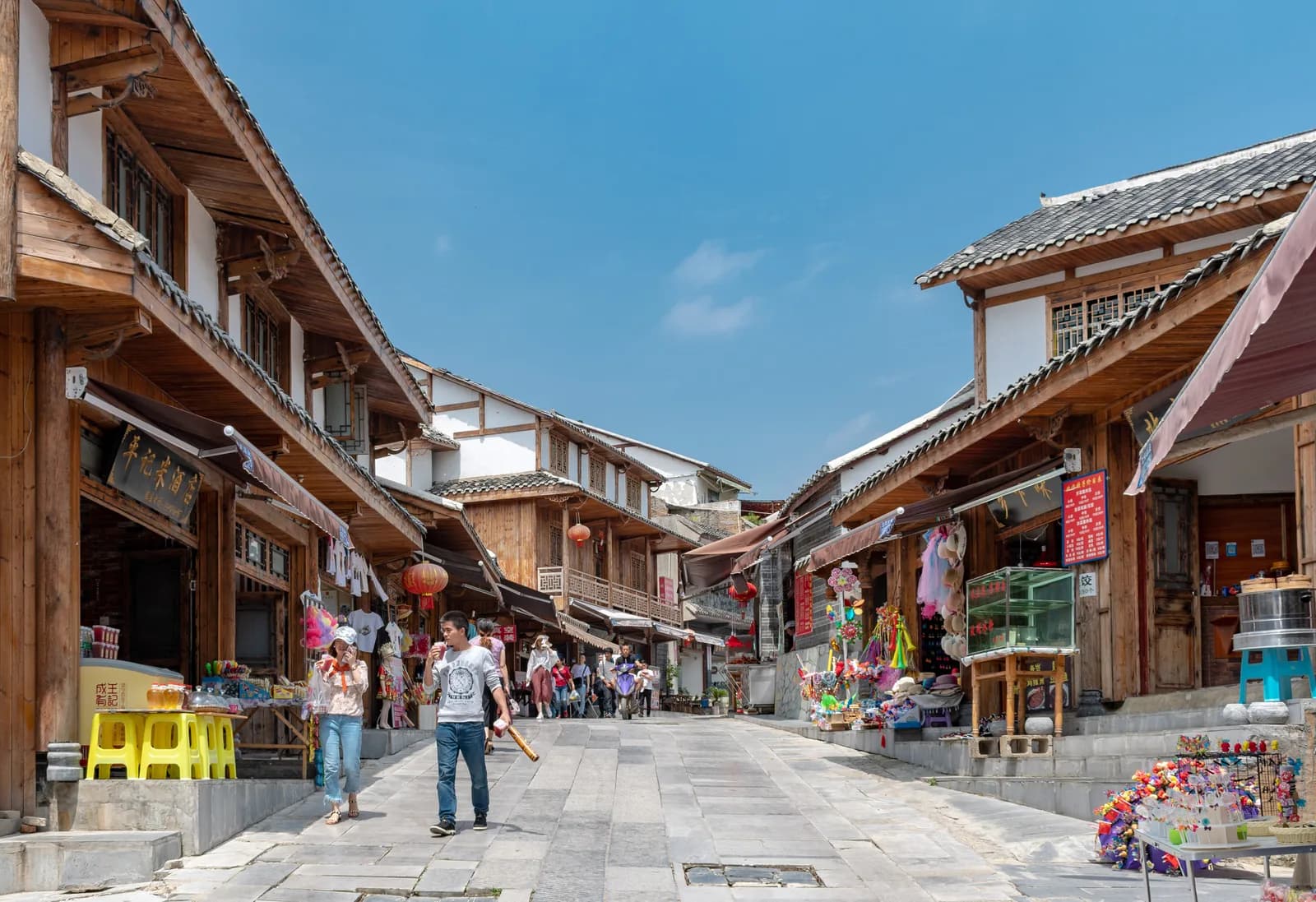
The old Guiyang isn't gone. Walk through Nanming district along the river toward Jiaxiu Tower and you'll find the city she'd recognise: street vendors selling rice noodles and sour-fish hotpot bowls for 25 RMB, narrow streets with low buildings, the riverside walkway in the evenings. But it's no longer the headline. The headline now is Yunyan's coffee strip and Guanshanhu's glass-tower business district, and any first-time visitor will feel both layers underfoot in the same afternoon.
First impressions: the elevated crossings and the scale
The first thing you notice in Yunyan is that you can't actually cross the road. The intersections are too big and the traffic too constant, so the city built elevated pedestrian crossings overhead at every commercial junction, and you funnel up onto a walkway, cross, descend on the other side. I kept saying I just wanted to cross the damn road, and I kept ending up on a bridge.
The second thing you notice is the scale. Greater Guiyang is roughly 8,000 km² with around 6 million people. The central districts (Nanming, Yunyan) blend into newer Guanshanhu without obvious borders. A 10-minute taxi from your hotel to a restaurant becomes 25 in real-world traffic, and the metro is the only sane way to make a cross-city move. Lines 1, 2, and 3 cover the bulk of where you'd actually want to go; everything else is Didi. Don't bother with the conventional taxis. They don't take foreign cards and the metered fare usually runs above Didi.
The third thing is the sheer building density. The Yunyan commercial strip where Captain George Coffee sits is genuinely indistinguishable, in the right light, from a Shanghai or Shenzhen mall area. There's a fancy outdoor mall, vinyl bars, specialty cafes, design hotels, and the whole apparatus of a city that's spent the last 15 years pulling itself up.
If you're a Kiwi who came in expecting the small, poor mountain capital, the scale alone reorganises that picture in about an hour. The Guiyang where-to-stay guide covers how the zones split up if you want to actually sleep in both versions on the same trip.
What surprised me most about Guiyang
A short reference of expectation versus reality:
| What I expected | What I found |
|---|---|
| Tea everywhere, coffee rare | Over 3,000 independent cafes, a world-champion barista, Yunnan-bean specialty roasters |
| Hard-to-navigate, low-tech city | Metro Lines 1-3, Alipay everywhere, Didi as ubiquitous as Uber in NZ |
| Few foreigners + curious stares | Confirmed, but friendly. Almost no English in restaurants, lots of curiosity |
| Limited international hotel options | Hyatt Regency, Hilton, Renaissance, all in Guanshanhu |
| Mostly Chinese restaurant menus | AI-translated English menus everywhere, hit-or-miss but workable |
A few specific things that stuck out enough to mention separately:
The Shiba Inu density. The breed-print rate in Guiyang signage and decor is on a level I haven't seen anywhere outside Tokyo. Shibas on cafe signs, Shibas printed on coffee cups, a Shiba mascot at the cold-brew place. I don't know if it's the Dogecoin-era pop culture spillover or just an ambient love of the breed, but it's a thing.
The smoke trays as decor. Half the cafes in the Yunyan coffee strip put complimentary smoke trays on the outdoor tables, sometimes with little branded ceramics. Smoking culture is far more visible here than in major coastal cities, and the cafes lean into it as an aesthetic. If you don't smoke, you're sitting next to people who do, especially outside in the evenings.
The plastic-feeling paper straws. Several places give you "paper" straws that don't melt, don't soggy out, and act exactly like plastic. Whatever the material is, it's a small upgrade I'd take back to Auckland.
The vinyl-bar coffee shop overlap. The Captain George flagship has a huge wall of speakers and a vinyl player tucked behind the counter; by night it flips to a jazz bar. This is more common in Guiyang than you'd guess. The Captain George coffee deep-dive covers the flagship in detail.
The coffee culture nobody mentions
If you knew one thing about Chinese drinks before coming, you knew tea. China, Japan, Korea, the Asian-tea triangle, that's the shorthand. Guiyang re-routes that.
The basic facts: Guiyang has crossed 3,000 independent cafes by recent counts, ranking among the densest specialty-coffee scenes in any Chinese city. Local roasters blend Yunnan-grown specialty beans (mostly the Pu'er region's lighter varietals) with Guizhou flavour signatures, including infusions with wild herbs, rice wine, osmanthus, and the local maojian tea. In 2025, Peng Jinyang of Captain George Coffee in Guiyang won the World Brewers Cup in Indonesia, and Guiyang's profile as a coffee city went international.
Practically: you can walk through Yunyan in an afternoon and queue at four or five championship-grade cafes. The standard latte at a chain is 25-35 RMB; the signature seasonal builds at a specialty shop run 65-100 RMB, which works out to about $10-15 NZD. By NZ standards, you're getting Auckland-priced coffee at Wellington-volume, and the quality at the top end matches anything I've had at home.
If you're going to spend a day on coffee, do Captain George Yunyan for the championship build, and walk the strip looking for "house-roasted" signs. Order one signature per shop, not a latte; the menus reward the creative pour-overs, not the milk drinks. I covered this in detail in the Captain George Coffee Guiyang review; the short version is that the queue is real, and the drink earned a 9.9/10 from me at the table.
The practical stuff (eSIM, super apps, paying)
Three things will mess up your first day in Guiyang if you don't sort them in advance:
Payment. Alipay and WeChat Pay run everything. Cash works at corner shops but feels antique. Both super-apps now accept foreign Visa and Mastercard if you link them before you arrive (setup is on the app itself; takes 10 minutes if you have your passport scan handy). Without one of these set up, you'll struggle to pay a Didi, order at a counter that's QR-only, or use the in-shop mini-programs that places like Captain George run for ordering and queue management. Sort this before you fly.
Connectivity. Get an eSIM that handles mainland China before you arrive. Airalo and Holafly both work, both bypass the local Great Firewall for normal Google / Instagram / WhatsApp use, both are 5-15 USD for a week. The free wifi at most cafes works, but the moment you step into a Didi or onto a metro, you need cell data. There are pockets in the Yunyan coffee strip where my Airalo signal cut out, which made the in-app Alipay payment hang. Have a backup payment QR cached as a screenshot.
Mandarin. You don't need it, but you'll need a translation app. Pleco is the best for menus (camera-translate works on handwritten signs), WeChat's built-in translate handles in-person conversation reasonably. The AI-translated English on most digital menus is poor enough to be entertaining but usable. If you're diaspora and have any Mandarin, this is the trip where it pays off; I got by mostly on pointing.
For broader Asia trip prep with similar payment and translation surfaces, the first-time Japan guide is the closest cousin to this post.
Where I'd stay if I came back
If you only have time to read one zone summary, here it is: stay in Yunyan if you came for the coffee, in Nanming if you came for the food and the river, in Guanshanhu if you came for the HSR and a modern hotel.
The longer version, with prose for each zone and the travel-style picks, is the dedicated Guiyang where-to-stay deep-dive. The short version:
Yunyan / Captain George area is the modern commercial strip with the championship coffee, the elevated walkways, the upmarket chain hotels. My base for this trip was here, and being a 10-minute walk from Captain George reshaped the rhythm of the days.
Nanming around Jiaxiu Tower is the old-town riverside, walkable to the densest food streets and the historic core. Best for first-timers and budget travellers.
Guanshanhu New District is the newer business zone with the Hilton, Hyatt Regency, and Renaissance, plus the HSR station. Best for comfort or if you're combining Guiyang with onward HSR travel.
If you're picking on autopilot:
- First-timer: Nanming, for the river-and-food walkability
- Budget: Nanming side streets, RMB 180-280 per night
- Comfort / business: Guanshanhu international chains
- Coffee tourist or returning diaspora: Yunyan
- Solo or sick partner at the hotel (this trip, basically): Yunyan, because everything's close
What I'd do differently next time
The Guiyang trip taught me three things to fix on a return visit:
Build in family time first, then plan the tourist days around it. I treated the coffee crawl and the Captain George visit as the main events, then noticed my Yunyan-based family were 15 minutes away by Didi and I'd already scheduled lunch in a different zone. If you're diaspora and have relatives here, ask them where they actually live and base your hotel within metro range. The home cooking is on a different level from street food.
Stay two nights in two zones, not three nights in one. Yunyan plus Nanming, on a three-night trip, would give the rebuilt and the old versions of the city in the same week. Doing it all from one base just means more Didi.
Don't try to film the coffee bar at peak. Captain George at lunchtime was so packed I gave up on b-roll inside the shop and shot the elevated pedestrian crossings from outside. A weekday afternoon visit, GoPro or iPhone framed wide from your seat, no flash, gets the shots without bothering the staff. The bridges over the Yunyan commercial strip give the best b-roll in the city anyway, especially at sunset.
Getting there, briefly
Most travellers arrive at Guiyang North Railway Station (Guanshanhu) by HSR. Beijing-Guiyang is 8-9 hours, Shanghai-Guiyang 10, Guangzhou-Guiyang 4-5. Tickets 600-1,400 RMB depending on class. Guiyang Longdongbao International Airport (KWE) sits 11 km southeast of the city with direct flights from major Chinese hubs and Bangkok. Metro Line 2 serves the airport, RMB 5-7 to the centre, slowest but cheapest. The Airport Bus runs every 30 minutes, RMB 25, faster. Didi to a downtown hotel is RMB 60-80 and quickest. Full transport detail is in the where-to-stay guide.
A rough daily budget
| Item | Backpacker | Mid-range | Comfort |
|---|---|---|---|
| Accommodation | $25-40 | $50-90 | $130-250 |
| Meals | $10-15 | $20-35 | $45-75 |
| Coffee + activities | $5-20 | $25-60 | $80-150 |
| Metro / Didi | $3-5 | $5-10 | $15-25 |
| Daily total (USD) | $43-80 | $100-195 | $270-500 |
For a 3-night Guiyang-only trip, $250-300 USD covers a comfortable backpacker stay. Mid-range hits $450-650. Comfort climbs past $900.
Recommendations
A short list of things I'd tell a Kiwi friend before they came:
- Link a foreign card to Alipay or WeChat Pay before you fly. This is the single most-impactful prep step.
- Buy an eSIM that handles mainland China (Airalo or Holafly). Patchy signal in the modern coffee blocks is real; cache a payment QR screenshot.
- Download Pleco for translation. Camera-translate is better than Google Translate for handwritten or printed Mandarin signage.
- Use the metro for cross-city moves. Lines 1, 2, 3 cover where you'll actually go; Didi is a fallback, not the default.
- Eat in Nanming and the older parts of Yunyan. Sour-fish hotpot, miǎn fěn rice noodles, the spicy lǔ flavour profile. The mall food courts are a distraction.
- Bring a hoodie in summer. Guiyang's elevation makes evenings cool, and the metro and mall AC runs colder than makes sense.
- Carry a zipped backpack at Qianling Park. The macaques will steal anything visible. A tote bag is a target.
- Plan a Captain George visit early. Mid-afternoon weekdays, queue is 15-25 minutes. Mid-day weekends, 45-60. Set the order via the in-shop mini-program and walk to a nearby cafe for the wait.
- Book HSR seats 3-5 days out if you're moving on to Kunming, Chongqing, or Chengdu. Last-minute HSR seats run out faster than the airline equivalents.
- Ask family where they actually live before booking a hotel zone if you're diaspora. The metro coverage is good, but proximity changes the trip.
Final note
I came in thinking I knew this city. I left realising I knew a version of it that's no longer the dominant one. The Guiyang my mum talked about is still here, in the old food streets and the river walks and the conversations my relatives have at home; the Guiyang I walked through on this trip is the rebuilt one, with the championship coffee and the elevated walkways and the design hotels. Both are real. The trick, for a first visit, is to give yourself enough days to see both. Two nights in Nanming for the food and the river, two nights in Yunyan for the coffee scene and the modern strip, and you'll come away with a real picture of the city instead of a snapshot.
If you want the specific zone-by-zone reasoning, the where-to-stay deep-dive is the next stop. If you want the championship-coffee piece on its own, the Captain George review is the deeper take. And if you're coming from elsewhere in our travel cluster, the asian-in-Colombia diary sits in the same dual-audience space as this one, written from the opposite hemisphere.
Frequently asked
Is Guiyang worth visiting as a first-time traveller to China?
Yes, especially as a paired stop on a longer Guizhou loop. As a single-city trip from far away, Guiyang isn't a top-3 first-China destination. Combined with Huangguoshu Waterfall, Qingyan Ancient Town, and a Miao village day trip, it becomes a strong week. The coffee scene, the food, and the much lower foreigner-tourist density make it feel like a real Chinese city instead of a curated one.
Is Guiyang safe for foreign tourists?
Yes. Guiyang is genuinely safe by both Chinese and international standards. The usual big-city precautions apply: watch bags on the metro, don't flash cash, use Didi after dark. Foreign tourists are rare enough that you'll get curious looks, especially outside the modern zones, but it's friendly attention, not threatening.
How long should I spend in Guiyang?
Two to three days for the city itself, four to five if you want to do Huangguoshu Waterfall and a Miao village day trip. One day barely covers Qianling Park and a Captain George visit. Two days adds Qingyan Ancient Town and a slower coffee afternoon. Three days lets you sleep in a different zone for a night and feel both sides of the city.
Do I need to speak Mandarin in Guiyang?
English signage and English-speaking staff are thin outside upper-tier hotels and a couple of specialty cafes. You'll get by with a translation app. Pleco is excellent for menus, WeChat translate works for in-person conversations, and the AI-translated English on most digital menus is hit-or-miss but usable.
What's the best month to visit Guiyang?
April is the cleanest single window: 15-22°C, low rain, the karst countryside green and the city comfortable. September and October are nearly as good if you can avoid the October 1-7 national holiday week. Summer (June-August) is the rainy season but stays cool. Winter is damp and cold; the worst of the four.
What surprises foreign visitors most about Guiyang?
The coffee scene. Most first-time visitors come expecting a tea city and find a coffee city: over 3,000 independent cafes, championship-winning roasters, and an entire commercial strip in Yunyan built around specialty drinks. The other big surprise is the elevation (Guiyang sits at around 1,070 m, so evenings cool fast even in summer), and the sheer density of modern infrastructure relative to the old reputation.
Can I use Visa or Mastercard in Guiyang?
Some upper-tier hotels and a few international chains accept them, but the practical reality is Alipay and WeChat Pay run everything else. Both apps now allow you to link a foreign Visa or Mastercard before you arrive. Set this up before flying; the experience without a working super-app payment method is genuinely difficult.