Guiyang Food Guide: What to Eat in Guizhou (and Where)
A Guiyang food guide from a Kiwi with family in the city: sour soup fish, changwang noodles, si wa wa, grilled tofu, the chili that is not Sichuan, and where to eat it all.
My mum's side of the family is from Guiyang, so I was eating this food long before I thought of it as a cuisine worth explaining to anyone. And the thing most Western food coverage gets wrong before it even starts: people assume Guizhou food is just Sichuan food with a different postcode. It isn't. Guiyang runs on a sour-spicy flavour that has almost nothing to do with the numbing Sichuan ma la or the dry Hunan burn that Westerners think of as "Chinese spicy." This is the eating map I wish someone had handed me the first time.
Guizhou food is not Sichuan food
Start here, because it reframes everything else. There's an old Chinese line that sorts the spicy provinces: Sichuan people aren't afraid of spice, Hunan people are afraid food won't be spicy, and Guizhou people are afraid food won't be sour. That last clause is the key to Guiyang.
The heat in Guizhou cooking comes from fermented chili, most famously ciba lajiao, a pounded chili paste, rather than the mouth-numbing Sichuan peppercorn. The sourness, the thing that actually defines the cuisine, comes from fermenting rice and wild tomatoes, not from splashing in vinegar. Food writers who've cooked the region's dishes (the Mala Market and Chinese Cooking Demystified both have detailed 2024-2025 breakdowns) keep landing on the same description: cleaner, tangier, and more direct than Sichuan, with the chili and the acid doing the work instead of the tongue-buzz.
It helps to know Guizhou is the home turf of Lao Gan Ma, the crispy-chili-oil jar in every overseas Chinese pantry. Tao Huabi started it from a Guiyang noodle shop in the late 1980s. The South China Morning Post ran a piece in early 2026 arguing Guizhou is effectively where China's chili culture was born. So the chili pedigree is real. It just expresses itself as sour-heat, not numb-heat. If you've only met Guizhou flavours through the diaspora-cooking lens I wrote about from Colombia, the home version is louder and more sour than you're expecting.
Two kinds of sour are worth knowing by name before you order. Red sour (hong suan) is the tomato-fermented broth you'll meet in sour soup fish, deep and slightly sweet. White sour (bai suan) is the paler rice-fermented base, sharper and more austere. Most travelers meet the red version first, but the better Miao restaurants will run both, and recent diners keep noting that asking for the white-sour option is the move that separates a tourist order from a local one.
The dishes worth crossing the city for
Here's the shortlist I'd build a few days of eating around, with the correct names so you can point at a menu or a sign. Prices are recent traveler-reported ranges; the rough USD/NZD is at mid-2026 rates.
| Dish | What it is | Heat profile | Rough price | Where to try |
|---|---|---|---|---|
| Sour soup fish (suan tang yu) | Fish hotpot in fermented red sour broth | Sour-spicy, medium | RMB 50-70 pp (US$7-10 / NZ$12-16) | Sit-down Miao-style restaurants |
| Changwang noodles | Pork intestine + blood-curd noodle soup | Spicy, savoury | RMB 13-15 (US$2 / NZ$3.50) | Breakfast noodle shops |
| Si wa wa (silk doll) | Roll-your-own veg in rice pancake | Sour-spicy dip | RMB 15-20 (US$2.50 / NZ$4) | Snack streets, markets |
| Grilled love tofu (lian'ai doufu guo) | Charred fermented tofu, chili-dip stuffed | Mild base, spicy dip | RMB 5-12 (US$1 / NZ$2) | Erqi Road, Qingyan |
| Rice tofu (mi doufu) | Cool rice-jelly cubes in red chili oil | Sour-spicy, cooling | RMB 8-12 (US$1.50 / NZ$2.50) | Markets, snack streets |
| Guizhou spicy chicken (laziji) | Braised chicken in ciba chili paste | Spicy, fermented | RMB 40-60 (US$6-8 / NZ$10-14) | Local restaurants |
| Huaxi beef rice noodles | Beef + herb broth over rice noodles | Mild, build-your-own | RMB 12-15 (US$2 / NZ$3.50) | Dedicated noodle shops |
Sour soup fish (suan tang yu)
This is the dish people mean when they say "Guizhou food." It's a Miao creation from the Kaili area in the southeast of the province, a fish hotpot poached at your table in a red, tangy broth fermented from rice and wild tomatoes. You fish out cooked pieces and dunk them in a chili-and-fish-mint dipping sauce. Reports consistently put a sit-down meal around RMB 50-70 per person, and recommend the older Miao-costumed restaurants (the Lao Kaili Suantangyu chain comes up repeatedly) over the glossier mall versions. If you eat one proper sit-down meal in Guiyang, this is it.
Changwang noodles
The breakfast institution. Changwang means pork intestine (chang) plus blood curd (wang), and the name happens to sound like the word for "prosperous," which is why street vendors a century ago liked selling it. It's a spicy, savoury noodle soup, and travelers flag Nanmenkou Changwang and Jiangjia Changwang as the morning queues worth joining. RMB 13-15 a bowl. It was named a provincial intangible-heritage dish in 2019, which tells you how seriously Guiyang takes its breakfast.
Si wa wa, grilled tofu, and rice tofu
The snack tier is where Guiyang gets fun. Si wa wa ("silk doll") is a build-your-own: a thin rice pancake you load with shredded radish, carrot, sprouts, kelp and herbs, roll up, and dip in sour-spicy sauce. Grilled love tofu (lian'ai doufu guo, literally "romance tofu") is charred fermented tofu split open and stuffed with a chili dip, a Guiyang street classic that George Stiffman's tofu-tour writing describes as having a dense, almost cheese-like chew. Rice tofu (mi doufu) is the cooling counterpoint: cubes of rice jelly in red chili oil, sour and soft. None of these will run you more than RMB 20. I'd graze across all three rather than commit to one.
Guizhou spicy chicken (laziji)
Not the dry, peppercorn-loaded Sichuan version. Guizhou laziji is braised and wetter, built on that pounded ciba fermented chili paste, with the heat coming up from underneath the dish rather than coating the top. The most respected versions trace to Guiyang, Qinglong and the Zunyi chili country to the north.
A warning the synthesis makes unavoidable: zhe'ergen (fish mint) is everywhere here, in dips, salads, and tucked into snacks. It tastes sharply of, well, fish and metal, and it splits visitors hard. Try a little before you commit to a plate of it.
Huaxi beef rice noodles
The everyday workhorse, and the dish I'd default to for a quick lunch. Huaxi beef rice noodles (Huaxi niurou fen) traces back over a century to the Huaxi district in the city's south, and it's a build-your-own bowl: slices of beef and rice noodles in a herb broth, finished at the table with sour pickled cabbage, coriander, and as much chili as your nerve allows. Reports put a bowl at RMB 12-15. It's milder than the rest of this list, which makes it the recovery meal after a heavy sour-soup-fish night.
Where to eat: the street-food scene
Guiyang's eating is densest on a few snack streets, and which one you pick depends on the hour. The reporting over the last 18 months is consistent on three.
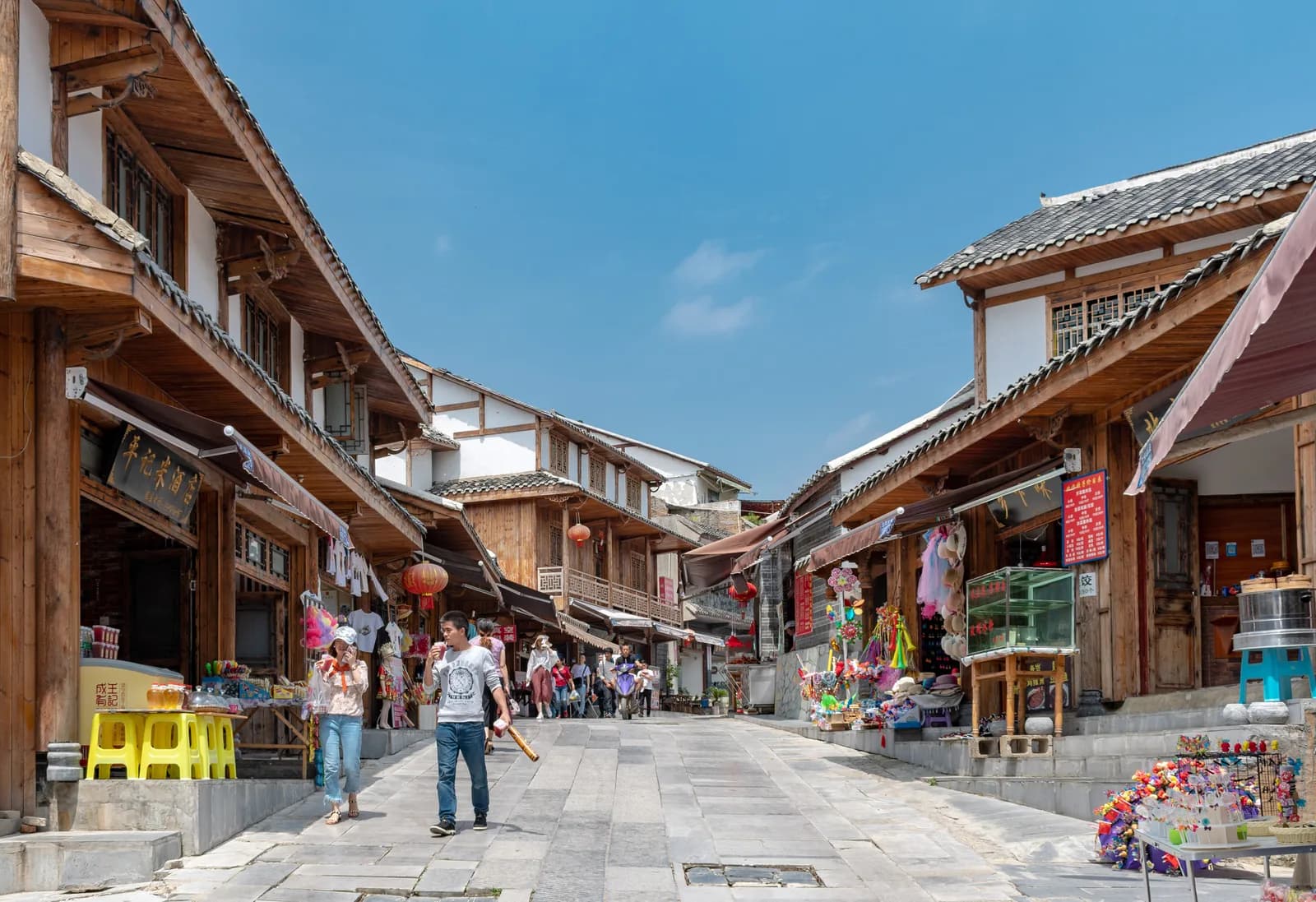
Erqi Road Snack Street in Nanming District is the famous one, a roughly 350-metre run at No. 29 Erqi Road that was a filming location for the documentary "A Bite of China." It packs the whole canon into one walk: changwang noodles, si wa wa, tofu balls, Huaxi beef noodles, Qingyan trotters. This is where I'd send a first-timer for a single grazing dinner.
The Qingyun Road night market is the neon, late-running option, rebuilt in recent years into a vintage-signage strip with street food, music and crowds. Travelers in 2025 describe it as the photogenic, contemporary version of the scene, busier and later than Erqi Road. The Hequn Lu / Shaanxi Lu cluster near the central fountain runs into the early hours (reports say stalls go until around 3am), and it's the no-frills, follow-the-locals choice.
For the day-trip eating, Qingyan Ancient Town to the south is its own food destination: Qingyan-style trotters, the famously dense local grilled tofu, and rose sugar sweets sold along the stone lanes. I've broken the half-day logistics down in the Guiyang day-trips guide, and the town also features in the things-to-do roundup.
The coffee plot twist
This is the part that surprised me most, and it's why this post crosses into territory my Captain George coffee deep-dive already stakes out. Guiyang, a city that was one of the poorer provincial capitals in China a generation ago, now has more than 3,000 coffee shops, the highest density in the country, ahead of Shanghai. In 2025, Peng Jinyang of local roaster Captain George won the World Brewers Cup, the global championship for filter coffee.
What makes it genuinely local rather than a copy-paste cafe boom is that the better shops fold Guizhou ingredients into the cups: cili (chestnut rose) americano, zhe'ergen (fish mint) cold brew, and drinks built on mujiangzi mountain pepper. That fish-mint cold brew is either a great idea or a dare, depending on who you ask, and it's the clearest sign that Guiyang's food identity is bleeding into its coffee rather than the other way round. If you've come for the eating, budget an afternoon for this too.
Where to stay for the food
You don't book a hotel in Guiyang for the food the way you might in a small town, but the zone you pick decides how far your dinners are. The short version: the real Guizhou cooking is densest in the older districts, and the coffee is in the newer ones. The full breakdown lives in the where-to-stay in Guiyang guide; here's the food-first cut.
Stay in Nanming if eating is the priority, which for this post it is. It's the old-town riverside core, it has Erqi Road and the snack streets on your doorstep, and you can walk to most of your meals without a Didi. Trade-off: it's the loudest zone at night. Choose Yunyan if you want the modern Guiyang and the coffee cluster, with the food still a short metro hop away; it's the best compromise zone. Pick Guanshanhu if you've arrived by high-speed rail and want international hotel comfort, accepting that you're 20-30 minutes by metro from the old-town eating. And consider Huaxi in the south only if you're chasing the Huaxi beef-noodle homeland and a quieter, cheaper, student-town base, knowing you're committing to a longer commute for everything else.
Travel-style picks
- First-timer: Nanming, near Erqi Road. Walkability to the food beats a shinier lobby.
- Budget: Nanming side streets a few blocks back from the river; rooms from around RMB 180-280 (US$25-40) and the cheapest eating in the city is at your feet.
- Comfort or business: Guanshanhu, where the Hilton and Hyatt Regency tier sits with the easiest HSR access.
- Diaspora visitor or coffee tourist: Yunyan, within metro range of both family neighbourhoods and the specialty-coffee strip.
Getting there and when to go
Most travelers arrive at Guiyang North Railway Station by high-speed rail (Guangzhou is 4-5 hours, Shanghai about 10, Beijing 8-9), or fly into Guiyang Longdongbao International Airport (KWE), 11 km southeast of the centre with Metro Line 2, an airport bus (RMB 25), and Didi (RMB 60-80) into town. Inside the city, the metro covers most of where you'd eat, and Didi fills the gaps. The full transport detail is in the where-to-stay guide and the broader Guizhou itinerary.
On timing, March-May and September-November are the clean, comfortable windows (15-25°C, low rain). Summer is the rainy season but stays cool given the 1,070 m elevation, so it's workable around the showers. Avoid the Spring Festival, May Day and early-October national holidays unless you want every snack street at maximum crush. The seasonal logic carries over from what I covered in first impressions of Guiyang.
Recommendations
A few things the synthesis makes me confident enough to hand over as rules:
- Eat your big sour soup fish meal at an older Miao-style restaurant, not a mall chain; the broth depth is the whole dish and the chains thin it out.
- Have changwang noodles for breakfast, not dinner, the way Guiyang actually eats it, and accept the morning queue at the named shops as the price of the good version.
- Try zhe'ergen (fish mint) in a small amount before you order a plate of it; it's the one flavour that genuinely divides visitors.
- Treat the snack streets as a progressive dinner. Graze si wa wa, grilled tofu and rice tofu across several stalls rather than filling up at the first one.
- Set up Alipay or WeChat Pay with a foreign card before you fly; even the street stalls and the coffee stands are effectively cashless now.
- Download Pleco for menu translation. English menus are thin outside upper-tier hotels, and the camera-translate handles Chinese characters better than the alternatives.
- Save an afternoon for the coffee even if you didn't come for it; the Guizhou-ingredient drinks are the local twist, not a Shanghai import.
- Carry a light layer at night. Guiyang sits high enough that summer evenings on the snack streets cool off faster than you'd expect.
Final note
The thing I keep coming back to is how badly the Sichuan assumption sells Guiyang short. This is a sour-first, ferment-driven food city that happens to also be the chili-sauce capital of China and, improbably, its coffee-championship capital too. Prices and places turn over fast in a food city, so if something here has moved since I last ate my way through, follow the rule that never fails in Guiyang: sit down wherever the locals are queuing. For the rest of the trip, the things-to-do guide, the day-trips breakdown, and the full Guizhou itinerary carry on from where the eating leaves off.
Frequently asked
What food is Guiyang known for?
Guiyang is known for sour soup fish (suan tang yu), changwang noodles (a pork-intestine and blood-curd breakfast noodle), si wa wa vegetable rolls, grilled love tofu (lian'ai doufu guo), Huaxi beef rice noodles, and Guizhou-style spicy chicken (laziji). It's also the birthplace of Lao Gan Ma chili sauce and, more recently, the most competitive specialty-coffee scene in China.
Is Guizhou food spicy like Sichuan food?
No, and that's the whole point. Sichuan heat is numbing (ma la) from peppercorns. Guizhou heat is sour-spicy (suan la): the chili comes from fermented chili pastes like ciba lajiao, and the sourness comes from fermented rice and tomatoes, not vinegar. It reads as cleaner and tangier than Sichuan, with no tongue-numb.
What is sour soup fish (suan tang yu)?
It's a fish hotpot in a red, tangy broth fermented from rice and wild tomatoes, a Miao dish from the Kaili area of southeast Guizhou. Fresh fish is poached at the table in the bubbling sour soup, and you dip cooked pieces in a chili-and-fish-mint sauce. Expect roughly RMB 50-70 per person.
What are changwang noodles?
Guiyang's breakfast institution: a spicy, savoury noodle soup built on pork intestine (chang) and blood curd (wang), named a provincial intangible-heritage dish in 2019. The name puns on the word for 'prosperous', which is why vendors a century ago liked selling it. A bowl runs RMB 13-15, and Nanmenkou Changwang and Jiangjia Changwang are the morning queues recent travellers say are worth joining.
Where is the best street food in Guiyang?
Erqi Road Snack Street in Nanming District is the dense, famous one (a former filming location for the show 'A Bite of China'). The Qingyun Road night market is the neon, late-night option, and the Hequn Lu / Shaanxi Lu cluster near the centre runs into the early hours. All three put the signature snacks within one walk.
How much does it cost to eat in Guiyang?
Cheap. A bowl of changwang or Huaxi beef noodles runs RMB 13-15 (about US$2 / NZ$3.50), a si wa wa plate RMB 15-20, and a sit-down sour soup fish meal RMB 50-70 per person. A full day of eating well rarely tops RMB 120-150 (US$17-21 / NZ$28-35) per person.
What is si wa wa (the 'silk doll')?
Si wa wa, literally 'silk baby,' is a thin rice-flour pancake you fill yourself with a rainbow of shredded vegetables (radish, carrot, bean sprouts, kelp, herbs), roll up, and dunk in a sour-spicy garlicky sauce. It's light, fresh, and a good counterweight to the heavier noodle and hotpot dishes.
Is the coffee in Guiyang actually good?
Surprisingly, yes. Guiyang has more than 3,000 coffee shops, the highest density in China, and in 2025 Peng Jinyang of local roaster Captain George won the World Brewers Cup. Local cafes also fold Guizhou ingredients into drinks: cili (chestnut rose) americano and zhe'ergen (fish mint) cold brew are real menu items.