Fanjingshan for Foreigners: Tickets, the 2pm Cutoff and Where to Stay (2026)
How foreigners get Fanjingshan tickets in 2026, the 2pm entry cutoff, getting there from Guiyang and Tongren, and where to stay near the East Gate.
I never made it to Fanjingshan while I was using Guiyang as a base, and it is the gap in my Guizhou trips that bugs me most. It is also the destination where the English-language internet fails hardest. Search "Fanjingshan tickets" and the results are Chinese tour operators and outdated guides, none of which answer the two questions that actually decide the trip: how does a foreigner buy a ticket for a mountain capped at a few thousand visitors a day, and what do the entry cutoffs mean for where you sleep? So this post is the researcher version, pieced together from the official ticketing policy, current booking platforms and traveler reports from 2025 and 2026, with everything date-stamped because Fanjingshan changes its rules more often than most Chinese parks.
Why tickets are the whole problem
Fanjingshan is a UNESCO World Natural Heritage site and the highest peak of the Wuling range, and to protect it the scenic area runs a hard daily cap. The official ticketing policy sets a maximum carrying capacity of 9,000 visitors a day (older English guides still quote 8,000 tickets, and both figures point at the same reality: a limited pool that sells out). Entry is by real-name reservation with time slots, and domestic pre-sales open a few days ahead through the official WeChat channels and Ctrip.
That system works fine if you have a Chinese ID card. It works badly if you have a passport. The reservation platforms are built around mainland ID numbers, which is why every current guide, and the scenic area's own English-language policy, funnels foreigners to in-person purchase instead. In practice the cap only bites at predictable times: weekends March through November, the July-August school holidays, and the big national holidays (May Day and the October 1-7 Golden Week), when domestic pre-sales can absorb the whole allocation days out. On an ordinary weekday, recent visitors report walking up and buying tickets without drama. The planning rule that falls out of this is simple: go midweek, avoid holidays completely, and be at the gate early. It is the same logic as the capped sites in my day trips from Guiyang post, just with much higher stakes.
How foreigners actually buy tickets (as of August 2026)
Here is the current procedure, cross-checked against the scenic area's ticketing policy and 2025-2026 traveler reports.
The dependable route is the ticket office. Bring your passport to the tourist center at the East Gate (Dongshanmen, on the Jiangkou County side) and buy there. Ticket machines will not read a passport, so join the staffed counter queue. Same-day sales run until 15:00 at the East Gate and 14:00 at the West Gate, but treat those as trivia rather than targets, because an afternoon purchase is useless once the climb cutoff passes (next section).
The sometimes-works route is Trip.com. The scenic area's official channels list Ctrip as a sales platform, and Trip.com (Ctrip's international arm) periodically lists Mount Fanjing entry that accepts passport details, exchanged at the tourist center with your passport. At least one foreign visitor in 2026 reported buying an afternoon slot online a week ahead and swapping it for a morning slot at the counter. My read: try Trip.com three to seven days out, take whatever slot exists, and treat a successful booking as a bonus rather than the plan. If it fails, the counter is still there.
Two more details worth knowing. Cable car tickets are separate, bought at the cable car office (passport again), and round trip is the sane choice because on-site queues for single tickets can run long in peak season. And build a fallback day into the itinerary. If the mountain is sold out or fogged in, having a spare day means the trip survives; the Guizhou itinerary post shows where that slack fits.
The 2pm cutoff: this is an overnight trip, not a day trip
The rule that reshapes the whole visit is buried in the operating hours. The park admits visitors from 7:00, hiking upward is prohibited after 14:00, and descending on foot is prohibited after 15:00, with late exits funneled onto the cable car. There is no hotel inside the reserve and overnighting on the mountain is banned outright.
Run the transport maths and the conclusion is unavoidable. From Guiyang, the fastest combination (high-speed train to Tongren plus a shuttle van) lands you at the East Gate around midday at best, which leaves no margin for the ticket counter, the mandatory shuttle bus up the valley, and a summit that genuinely takes five or more hours to do properly. Recent visitors are unanimous that the mountain rewards the first entries of the day, both for the light and because the Red Clouds Golden Summit queue is shortest before mid-morning.
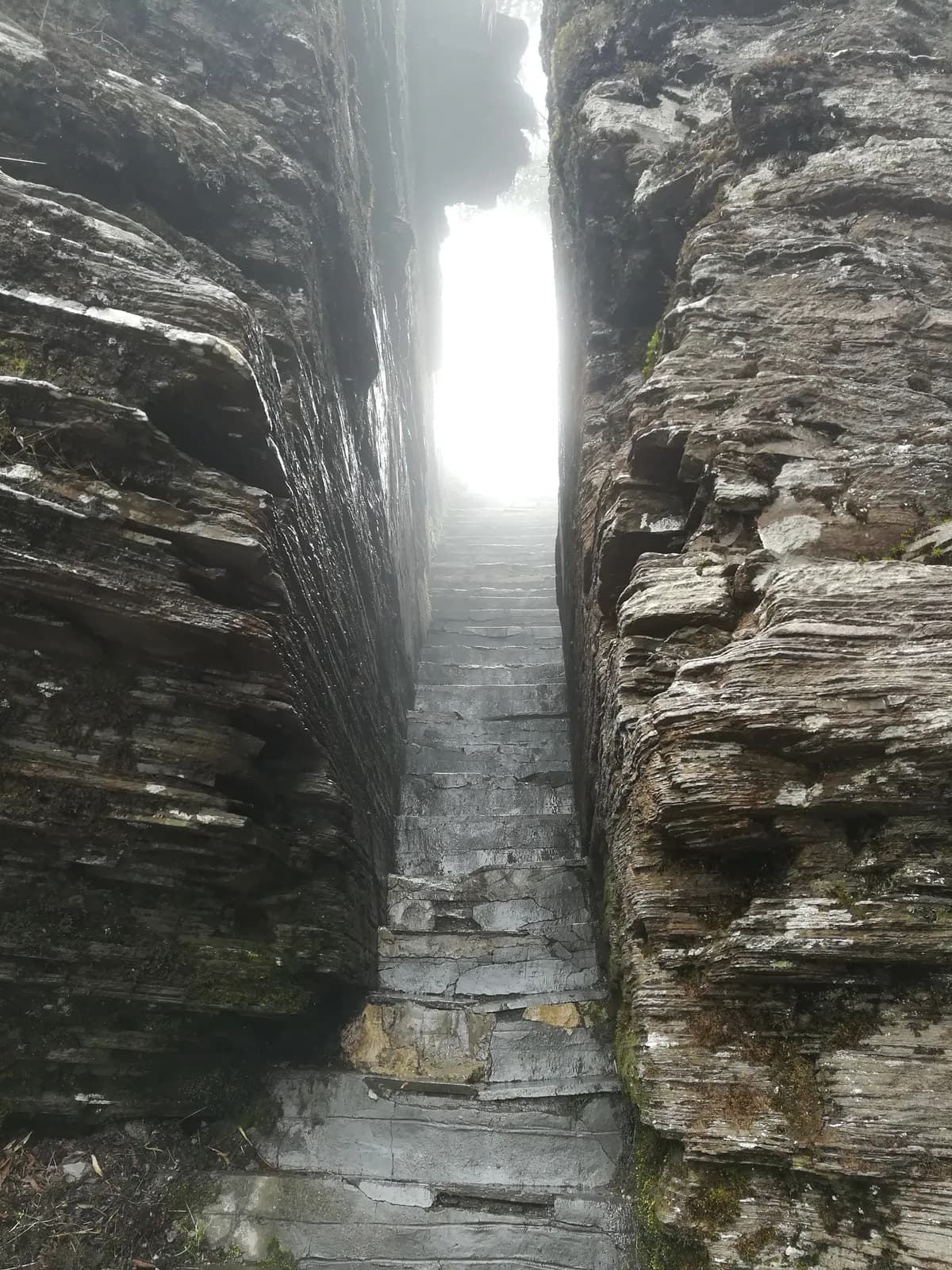
So the itinerary that actually works is: arrive the afternoon before, sleep within striking distance of the East Gate, be at the ticket office when it opens, and ride the first shuttles up. That forced overnight is not a bug. The homestay cluster at the gate exists precisely because of it, and it turns Fanjingshan from a brutal day trip into a relaxed two-day loop out of Guiyang.
East Gate or West Gate?
Fanjingshan has two entrances on opposite sides of the mountain, and they are very different products.
| East Gate (Dongshanmen) | West Gate (Xishanmen) | |
|---|---|---|
| County | Jiangkou | Yinjiang |
| Way up | Cable car (about 10 min) or ~6,600 steps (3-5 hr) | Hiking only, 2-3 hr ascent |
| Crowds | High; time-slot pressure | Low year-round |
| Same-day sales end | 15:00 | 14:00 |
| Nearby beds | Homestay cluster at the gate, Jiangkou town | Sparse |
| Best for | First-timers, anyone using the cable car | Fit hikers wanting quiet |
The East Gate is the default and the one this guide assumes: it has the cable car, the tourist center where foreigners buy tickets, and almost all the accommodation. The West Gate, on the Yinjiang side, has no cable car and a longer, wilder ascent, and reviewers who used it describe having the trail nearly to themselves even in season. A Singaporean visitor in April 2026 rode the connecting shuttle between gates and trekked the western route before descending by cable car on the east side, which is the best of both if your knees and timetable allow it. Unless that describes you, book everything around the East Gate.
On the mountain: cable car, the QR queue, and how long it takes
The sequence at the East Gate goes: ticket check, mandatory shuttle bus up the valley (about 30 minutes), then the choice between the cable car and the stairs. The cable car takes roughly 10 minutes; the stairs take three to five hours and 6,600 steps. Note that the cable car closes for maintenance in winter (January 20 to February 6 in 2026), which turns the climb into the only option, so check before a winter trip.
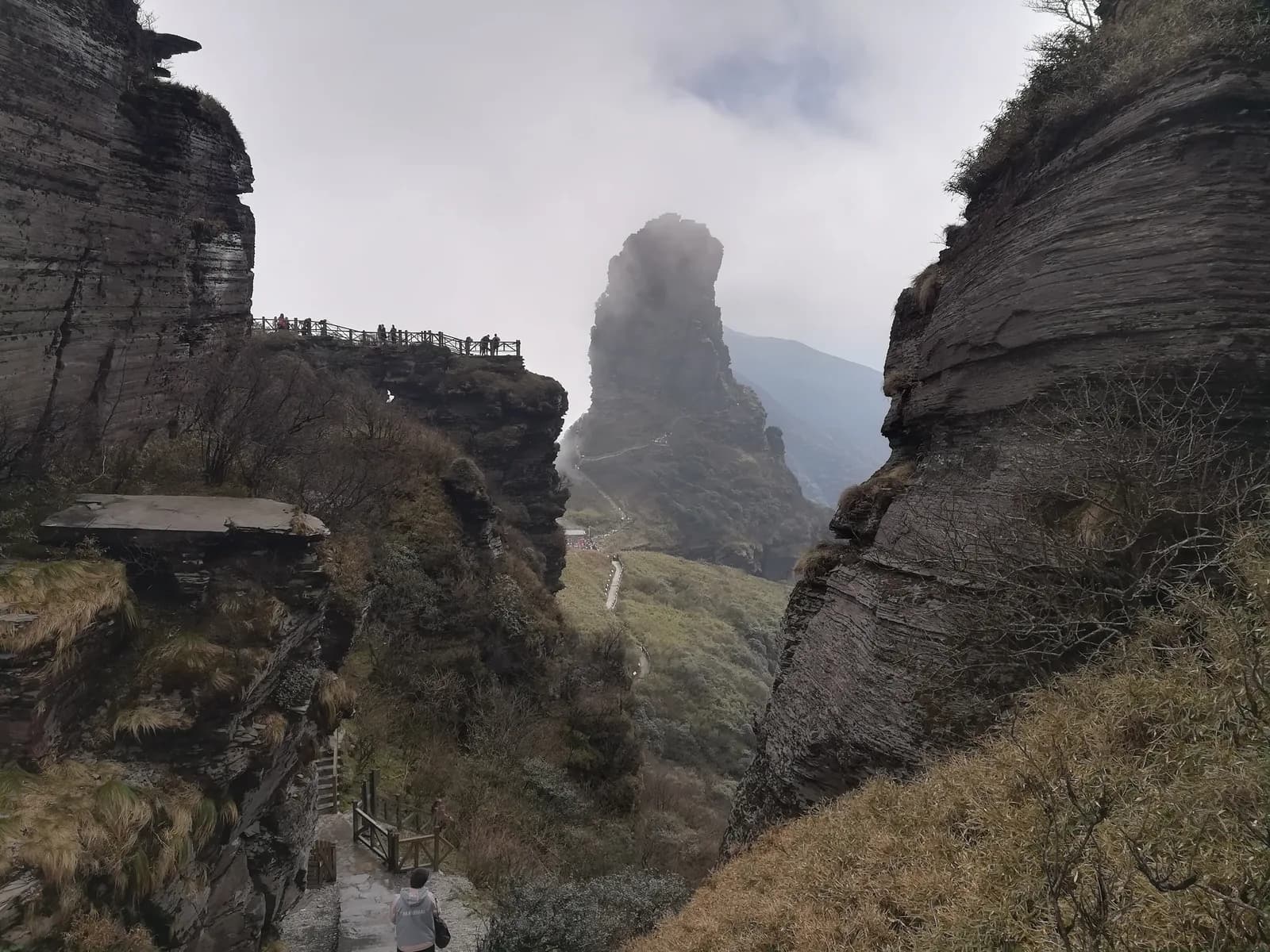
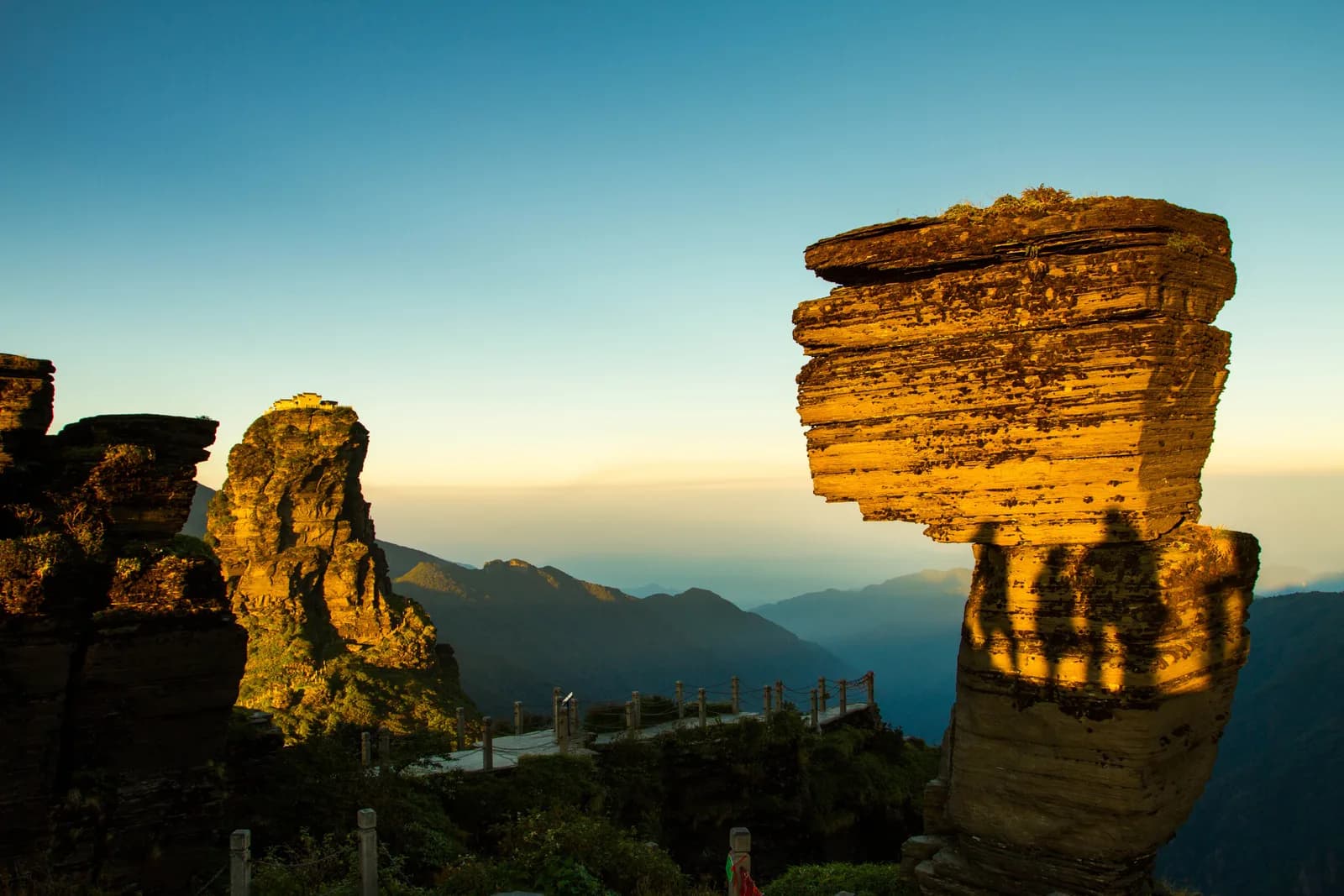
At the top, the headline act is the Red Clouds Golden Summit, the 100-metre rock spire with twin temples joined by a sky bridge. Access runs on a virtual queue: scan the QR code posted near the Mushroom Stone or Pudu Square and wait for your number. Trip.com reviewers in 2025-2026 pass on the same hack repeatedly: scan the moment you can (one Malaysian visitor's version is "as soon as you pass the 14th cable car pillar"), because slots vanish fast, and if the queue is already 300-plus deep, walk the Old Golden Summit and Mushroom Stone first and circle back. Queue reports range from under an hour on April weekdays to four hours on peak weekends. The final ascent itself is a steep scramble up chained stairways cut into the rock, which reviewers describe as sketchy when wet, and it is cold up there even in May, so pack a warm layer regardless of the forecast in the valley.
Between the summit spire, the Old Golden Summit, Cheng'en Temple and the boardwalks, a proper visit is five to seven hours on the mountain. If sorting all of this solo sounds like more admin than holiday, a Fanjingshan day tour from Guiyang bundles transport and tickets, and it is the one Guizhou trip where I think the tour premium genuinely buys something, because the ticket risk transfers to the operator.
Where to stay near Fanjingshan
The overnight is compulsory in practice, so the real question is which of the three bases fits your trip. All of them are cheap by any Kiwi standard; the average Jiangkou room runs around US$54 a night.
Stay at the East Gate cluster if beating the morning queue is the priority, which for a first visit it should be. A strip of homestays and small guesthouses sits within walking distance of the tourist center. Fanyushan Yuxi Homestay gets repeat mentions for being a few minutes on foot from the ticket gate, and Fanjingshan Mountain and River Sample Homestay is about a 20-minute walk out. The trade-off is limited dinner options and slightly higher prices than town for what you get.
Pick Jiangkou county town, 22 km and a 30-40 minute drive from the tourist center, if you want an actual hotel. The four-star Yeste Select Hotel and the Jiangkou Fengqi Hotel offer proper rooms and service at prices the gate cluster cannot match, and the town has real restaurants. You give back the walk-to-the-gate advantage, so book a driver or Didi for 6:30am.
Choose Tongren city if your trains or flights dictate it. It is the transport hub, roughly 70 km and over an hour from the East Gate, with the widest hotel choice, but it converts your morning into a 5:30am start. Treat it as the arrival or departure night, not the pre-mountain night. And the Yinjiang side only makes sense for West Gate hikers, with thin options.
Travel-style picks: first-timers should take an East Gate homestay for the 7am head start. Budget travelers do the same but book the simpler guesthouses a street back from the gate, from around RMB 150. Comfort seekers want the Yeste Select in Jiangkou with a pre-booked morning transfer. Families are best in Jiangkou town too, where dinner and pharmacies are not a negotiation.
Getting there and when to go
From Guiyang, the clean route is a high-speed train to Tongren, 1.5-2 hours, booked a few days ahead on Trip.com or 12306 exactly as for any Guizhou leg. Outside Tongren Railway Station, shuttle vans run to the East Gate tourist center for about RMB 35, taking around 70 minutes, departing roughly hourly from 07:00 to 19:00. The lazier alternative is the direct tourist bus from Guiyang, about 4 hours door to gate. Tongren Fenghuang Airport is the closest airfield if you are connecting from another region. Many itineraries pair Fanjingshan with Zhenyuan Ancient Town on the rail route back toward Guiyang, which turns the trip into a satisfying three-day eastern Guizhou loop; the full sequencing lives in the Guizhou itinerary.
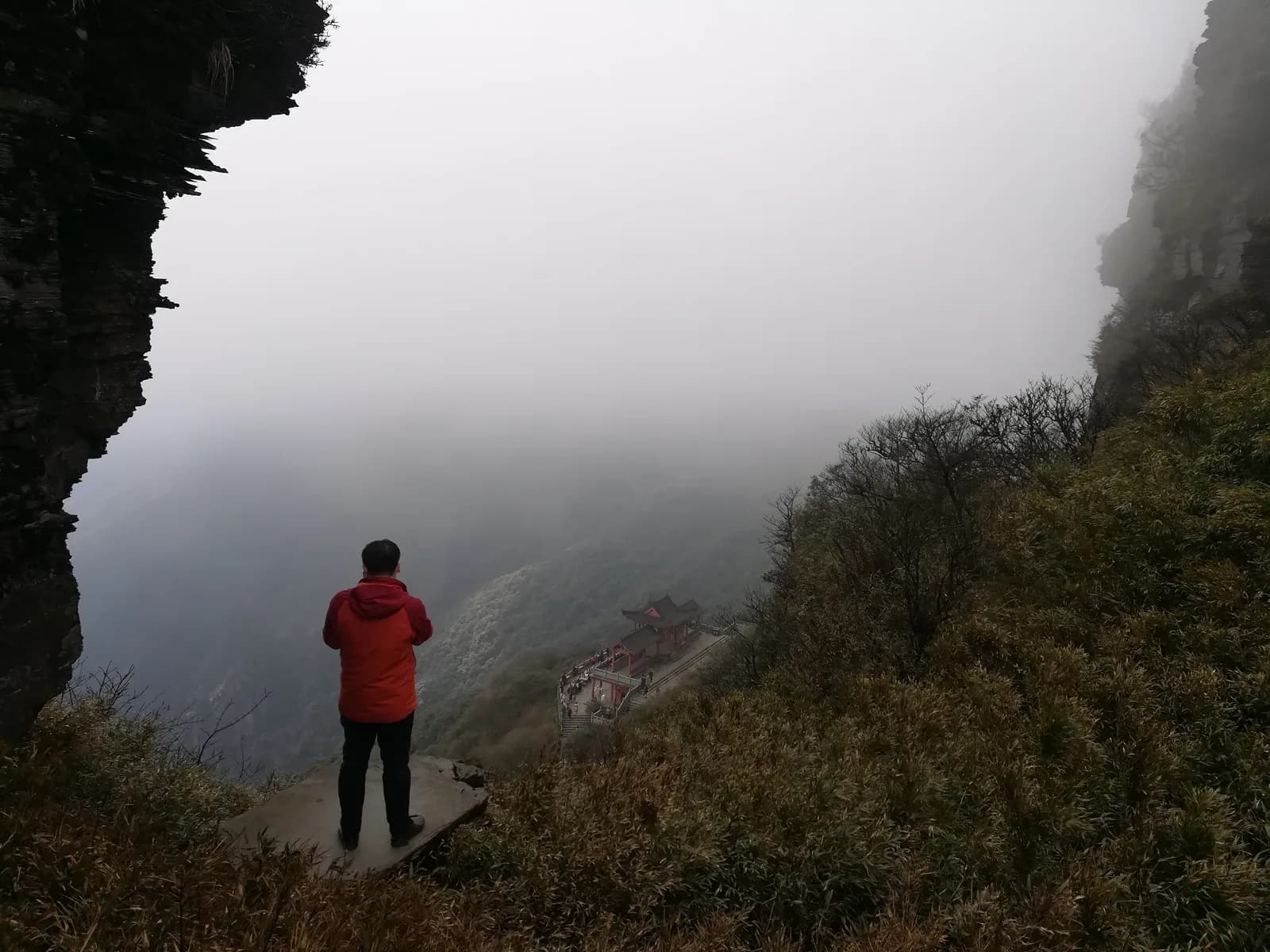
On timing, the consensus across recent reports is April to June and September to October: the best odds of the cloud sea without the fog whiteouts, and manageable queues on weekdays. July and August bring school-holiday crowds and afternoon storms. Winter is quiet and occasionally gives you the mountain under snow, but the cable car maintenance window and summit closures make it a gamble. The mountain makes its own weather year-round, and plenty of visitors see nothing but white; that is the risk you accept, and it is why the spare day matters. Avoid May Day and Golden Week without exception.
What it costs
Rough per-person figures for the standard overnight trip from Guiyang, at August 2026 prices. RMB 100 is about US$14 or NZ$23.
| Style | Sleep | Mountain spend | Daily all-in |
|---|---|---|---|
| Backpacker | Gate-cluster guesthouse RMB 150 | Entry + shuttle, climb up, cable down (~RMB 230) | RMB 550-750 |
| Mid-range | East Gate homestay RMB 250-400 | Entry + shuttle + return cable car (~RMB 300) | RMB 800-1,100 |
| Comfort | Yeste Select, Jiangkou RMB 300-500 | As above plus private transfers | RMB 1,400-2,000 |
The mountain line items, for checking against whatever the counter charges you: entry RMB 100 in peak season (cheaper December to February), the mandatory valley shuttle around RMB 20-30 each way, cable car RMB 70 each way. Prices here shift often enough that I would treat anything more precise than this as already stale.
Recommendations
What I would tell a Kiwi friend booking this trip today:
- Go midweek. The daily cap only really bites on weekends, school holidays and national holidays; a Tuesday in May is a different mountain from a Saturday.
- Sleep at the East Gate the night before and be at the ticket office for 7am opening with your passport. This single decision fixes the ticket risk and the queue risk at once.
- Try Trip.com for tickets three to seven days out, but keep the counter as your real plan and take any slot you can get (morning swaps at the desk have worked for recent visitors).
- Buy the cable car round trip. Peak-season queues for on-site singles have run past two hours in recent reports.
- Scan the Golden Summit QR code immediately once you are up top; reviewers say the virtual queue fills within minutes of opening.
- Pack a warm layer and grippy shoes whatever the season. Summit reviews from May 2026 still say "freezing," and the final chained stairways are slick when wet.
- Carry cash-loaded Alipay or WeChat Pay plus your passport; the counters, shuttles and snack stalls all assume Chinese payment apps, and the passport gets checked repeatedly.
- Eat before you go up. Food on the mountain is scarce and dear; the visitor center and your homestay are the sensible feeds.
- Build in a spare day. Fog or a sell-out can kill a rigid plan; a flexible one just shuffles.
Final note
Fanjingshan is the one Guizhou trip where the logistics genuinely gatekeep the experience: the people who read the rules see one of the best mountains in China, and the people who wing it get turned around at a ticket window at 2pm. The formula is short. Midweek, sleep at the gate, passport at the counter at 7am, QR code at the top, warm layer in the bag.
I have not stood on that summit yet, so this is the researcher's version, built from the official policy and the travelers who went in 2025 and 2026. If you have been recently and something here has changed, tell me and I will update it. For the rest of the region, start with the Guizhou itinerary, the day trips from Guiyang and the where to stay in Guiyang guide, and if you are routing back through the east of the province, Zhenyuan Ancient Town is the natural pairing.
Frequently asked
Can foreigners buy Fanjingshan tickets online?
Mostly no. Fanjingshan runs on a real-name reservation system built around Chinese ID numbers, so the WeChat mini-program and domestic apps that mainland visitors use will not accept a passport. As of 2026, the reliable route for foreigners is buying in person at the ticket office in the East Gate tourist center with your passport. Trip.com sometimes lists passport-friendly tickets that you exchange at the tourist center, and it is worth trying a few days out, but do not build your plan around it working.
Do Fanjingshan tickets sell out?
Yes, regularly. The official ticketing policy caps the mountain at 9,000 visitors a day (many English guides still quote 8,000), with time-slot entry, and domestic pre-sales open a few days ahead. On weekends, in July and August, and on any Chinese public holiday, allocations can be gone before foreigners get near the ticket window. Recent visitors consistently advise a weekday visit and arriving at the gate for opening around 7am.
What is the 2pm rule at Fanjingshan?
The scenic area stops letting people hike upward after 14:00, and same-day ticket sales at the East Gate stop at 15:00 (14:00 at the West Gate). Descending on foot is prohibited after 15:00, so late-afternoon exits happen by cable car. There is no accommodation inside the reserve and overnighting on the mountain is banned, which is why almost everyone sleeps near a gate the night before and enters early.
How do you get to Fanjingshan from Guiyang?
Take a high-speed train from Guiyang to Tongren, about 1.5-2 hours, then a shuttle van from outside Tongren Railway Station to the East Gate, around RMB 35 and 70 minutes, departing roughly hourly from 07:00 to 19:00. There is also a direct tourist bus from Guiyang that takes about 4 hours. Either way, the timings mean a same-day ticket purchase plus climb is a gamble, so plan to sleep near the gate.
Where should you stay for Fanjingshan?
For a first visit, stay in the homestay cluster at the East Gate in Jiangkou County, where places like Fanyushan Yuxi Homestay sit a few minutes' walk from the ticket gate. Jiangkou county town, 22 km away, has proper hotels like the four-star Yeste Select at lower prices. Tongren city works if you need the railway station or airport, but it means a very early start to beat the ticket queue.
How much does Fanjingshan cost?
Budget around RMB 300 per person for the mountain itself: RMB 100 entry (peak season), roughly RMB 20-30 each way for the mandatory shuttle bus, and RMB 70 each way for the cable car. Add a night near the gate (homestays from about RMB 150-400) and transport from Guiyang, and a realistic all-in figure is RMB 700-1,100 per person for the overnight trip.
Is Fanjingshan worth the hassle?
Recent travelers overwhelmingly say yes, with caveats. The Red Clouds Golden Summit, the twin temples and the Mushroom Stone are the images that sell Guizhou, and visitors in 2026 still describe standing above the cloud sea as the best thing they did in the province. The caveats are real: fog can erase the views, summit queues run one to four hours in peak season, and the ticket system punishes anyone who turns up without a plan.