Things to Do in Bogotá: What's Worth Booking and What to Skip
The best things to do in Bogotá, ranked by what recent travellers actually rate: Monserrate, the Gold Museum, graffiti tours, markets, day trips, and what to DIY.
I spent a couple of weeks in Bogotá before pushing on to Medellín and Cartagena, and the question I kept coming back to is the one worth answering before you book: of everything Bogotá throws at you, what actually earns a place on a two or three day itinerary, and where the paid tour is worth it over doing it yourself.
The pattern across recent traveller reports is consistent. Bogotá's best stuff splits cleanly into two buckets: a free or near-free museum-and-history core that you can self-guide, and a short list of tours and day trips where paying a guide genuinely changes the experience. Get that split right and the city punches well above the reputation it had a decade ago. Below is the shortlist, what you'll pay in Colombian pesos with rough USD, and the honest verdict on each.
The Bogotá shortlist, ranked by what travellers rate
Here's the consensus order from recent firsthand accounts, the Bogotá TripAdvisor forum, and r/Bogota threads, with realistic prices (roughly 4,000 COP to 1 USD in mid-2026):
| Activity | Typical cost | Time | Verdict |
|---|---|---|---|
| Museo del Oro (Gold Museum) | 4,000 COP (~$1), free Sun | 1.5–2 hrs | Near-universal "worth it," do it yourself |
| La Candelaria graffiti tour | Free–tip (~40,000 COP) or ~55,000 COP paid | 2–2.5 hrs | Highly rated, pay for the guide |
| Monserrate (funicular/cable car) | 2–3 hrs | The view; go at sunset | |
| Botero Museum | Free | 1 hr | Easy free win next to the Gold Museum |
| Paloquemao market food tour | ~$30–90 USD pp | 3 hrs | Worth the guide; fruit you can't name |
| Ciclovía (Sunday bike scene) | Free; bike ~$1/30 min | Half day | The most local thing you'll do |
| Usaquén Sunday flea market | Free entry | 2–3 hrs | Pleasant, pair with Ciclovía |
| Andrés Carne de Res (Chía) | ~150,000–250,000 COP pp | A whole night | An event, not a meal; polarising |
| Zipaquirá + Guatavita day trip | ~$90–110 USD tour | Full day | Book the tour, hard to DIY |
| Villa de Leyva | Tour or overnight | 1–2 days | Worth it, but stay over |
The rest of this guide breaks down the calls that actually matter.
Monserrate: the view, and why most people shouldn't walk
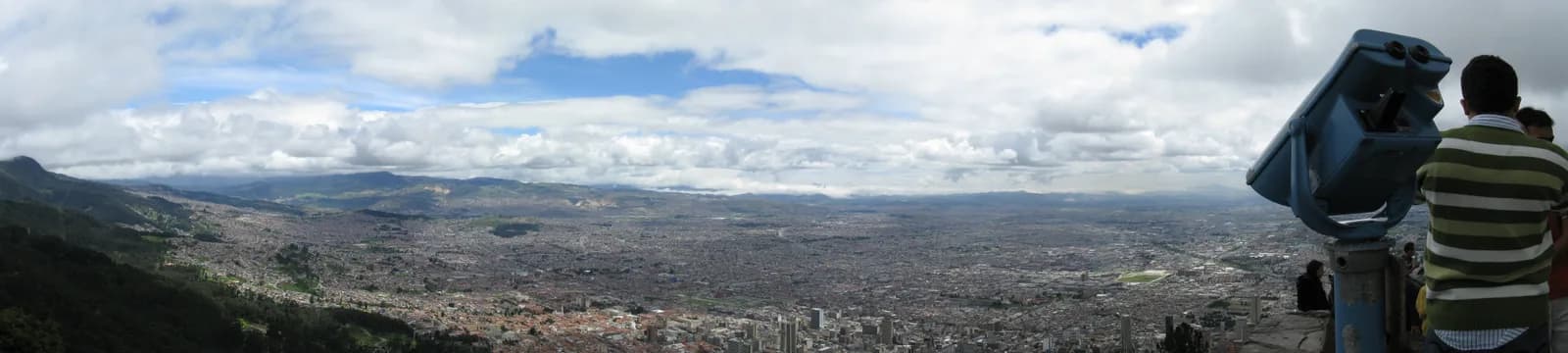
The hill behind the city is the one sight nearly every recent visitor agrees on. Monserrate tops out around 3,150 metres, with a sanctuary, a couple of restaurants, and the panorama that puts Bogotá's sheer size into perspective. The dominant theme in recent reports is timing it for late afternoon, so you catch daylight, sunset, and the city lighting up, then ride back down in the dark.
Get up there by funicular or cable car. A roundtrip ticket runs about 35,000 COP (roughly $9 USD), and travellers consistently recommend buying online to dodge the queue, which gets long on weekends and brutal on Sundays when locals pile up too. The walking trail (2.5 km, steep, about an hour) divides opinion sharply: fit, altitude-adjusted hikers rate the challenge, but more reports than not say skip it, both because the path itself isn't scenic and because solo walkers are advised to go only in a daytime weekend crowd for safety. Given Monserrate climbs higher than the city you're already struggling to breathe in, this is a day-two or day-three activity, not a jet-lagged-day-one one. The honest take in my first-impressions-of-Colombia post is that the altitude is the thing people underestimate most.
The free core: Gold Museum, Botero, and La Candelaria
Here's the part that surprises people: Bogotá's best museums cost almost nothing. The Museo del Oro (Gold Museum) is the headline, with more than 55,000 pieces of pre-Hispanic goldwork and the single most repeated "do not miss this" in recent accounts. Entry is just 4,000 COP (about $1) Tuesday to Saturday and free on Sundays, though Sunday is also when it's heaving, so a weekday late-morning slot is the sweet spot. Over 90 percent of the exhibits have English signage and there are free English guided tours Tuesday to Saturday. It's closed Mondays.
A short walk away, the Botero Museum is genuinely free and pulls around half a million visitors a year. Beyond Fernando Botero's signature inflated figures, the collection quietly includes works by Picasso and Monet, which catches people off guard. Both museums sit inside La Candelaria, the colonial old town, which is itself the third free activity: wander Plaza de Bolívar, the painted facades, and the steep lanes by day. Recent reports are blunt that La Candelaria is a daytime zone, poorly lit and pickpocket-prone after dark, so do your wandering before evening and base yourself elsewhere (more on that below).
The one thing in this district worth paying for is a graffiti tour. Bogotá has become a serious street-art city, and travellers overwhelmingly say the murals only land once a guide explains the politics, the artists, and why the city's stance on street art shifted. The long-running Bogotá graffiti walking tour runs on a tip basis (budget around 40,000 COP) and a 2.5-hour version sits around 55,000 COP (~$13). The recurring critique is that some routes lean toward commissioned, gallery-sponsored walls, so a tour with strong reviews for its guide is the one to pick.
Markets and the Sunday city: Paloquemao, Usaquén, Ciclovía
Two of Bogotá's best experiences are tied to a market, and one is tied to a day of the week. The Paloquemao market is the food highlight. You can walk in free and browse the flower, fruit, and meat halls yourself, but this is the rare case where the tour earns its fee: guides hand you 20-plus tropical fruits you've never heard of (lulo, mangostino, granadilla, the lot) and explain what you're tasting. A Paloquemao market food tour runs roughly $30 to $90 USD depending on group size, lasts about three hours, and shows up again and again as a trip highlight. Go early, wear shoes with grip (the floors are wet), and don't eat breakfast first.
Sunday is its own attraction. From 7am to 2pm the city shuts more than 100 km of road for the Ciclovía, and around 1.5 million people walk, run, skate, and cycle the empty avenues. It's free; the MUVO bike-share app rents wheels at roughly $1 USD per half hour. Multiple recent posts call it the most genuinely local thing a visitor can do in Bogotá, and the smart move is to ride north and finish at the Usaquén Sunday flea market (Calle 119 with Carrera 6, roughly 9am to 5:30pm Saturdays and Sundays), a leafy colonial square turned crafts-and-antiques market with mochilas, coffee, and a strong lunch scene. The two pair into one easy, low-cost Sunday.
Andrés Carne de Res: an event, not a dinner
No Bogotá list is complete without Andrés Carne de Res, the maximalist restaurant-meets-theatre in the town of Chía, about 45 minutes to an hour north of the city. Recent reviews are split in a very specific way: almost everyone agrees the atmosphere is unlike anything else (spontaneous performances, dancing staff, a party that runs late, decor that defies description), and almost everyone agrees you go for that, not for consistent food. Prices are high for Colombia and the kitchen can be hit-or-miss, so treat it as a once-per-trip night out rather than a meal. Reservations are strongly advised for weekends, and there's a closer-in branch, Andrés D.C. in the Zona Rosa, if you don't want the Chía drive. If you go to Chía, sort a ride both ways before you start drinking; this is not a stumble-home situation.
Day trips: what to book and what to DIY
The countryside around Bogotá is where the day-trip money goes, and the split between paid and self-guided is clear in recent reports.
| Day trip | Distance from Bogotá | Best done as | Worth it? |
|---|---|---|---|
| Zipaquirá Salt Cathedral | ~1 hr | Tour or DIY by train/bus | Yes, the standout |
| Guatavita Lake | ~1.5–2 hrs | Tour (hard to reach solo) | Yes, paired with Zipaquirá |
| Villa de Leyva | ~3–4 hrs | Overnight | Yes, but don't day-trip it |
The Zipaquirá Salt Cathedral is the consensus best day trip: a working salt mine with a cathedral carved 180 metres underground, dramatic in a way photos undersell, and reachable independently if you're happy with buses and the tourist train. Guatavita Lake, the near-perfect circular crater tied to the El Dorado legend, is the one that justifies a tour, because it's awkward to reach by public transport. The dominant recommendation is to combine the two: a Zipaquirá and Guatavita day tour runs around 400,000 COP ($90 to $110 USD), and travellers flag that morning departures (and Saturdays over Sundays) dodge the worst queues at the cathedral. Villa de Leyva, a large colonial square town further out, draws strong praise but the recurring warning is not to cram it into a single day from Bogotá; the 3-to-4-hour each-way drive eats the trip. Stay a night.
Where to stay between activities
Your base decides how much of this list you actually do, because Bogotá's zones trade walkability against safety and price. This is the short version; the full where to stay in Bogotá breakdown compares hotels in each.
Stay in Chapinero and Zona G if you want Bogotá's best restaurants and cafés on your doorstep with a safe, walkable, central feel; it's the all-rounder most recent visitors land on. Stay in Zona Rosa / Zona T if you want nightlife and shopping clustered into a few pedestrian blocks. Stay in Parque 93 / Chicó if you want the quietest, most polished and most security-conscious zone, popular with business travellers, at the cost of being a cab ride from the old town. Stay in Usaquén if you want a village-within-the-city feel, the Sunday market on your doorstep, and a calmer base that suits families. Stay in La Candelaria only if walking out the door into the historic sights matters more to you than evenings; it's cheap and central but the after-dark reports keep it a daytime-first pick.
Travel-style picks
First-timers, base in Chapinero / Zona G: safe, central, walkable, and close to the food. Budget travellers, La Candelaria for the cheapest beds beside the sights, with the caveat to taxi back at night. Luxury, Parque 93 / Chicó for the upscale hotels and the security. Families or long, quiet stays, Usaquén. The full comparison, with named hotels and a budget table, is in the where to stay in Bogotá guide.
Getting there and when to go
Bogotá's El Dorado airport (BOG) is one of Latin America's busiest hubs, with direct flights from across the US, Europe, and the region, plus cheap domestic hops to Medellín and Cartagena that usually beat the bus. From the coast it's a one-hour flight; if you're routing a wider Colombia trip, the Cartagena things to do guide and the where to stay in Cartagena breakdown cover that end, and Bogotá makes the most sense as the trip's altitude bookend rather than its middle, for the temperature-swing reasons laid out in the first-day-in-Colombia post.
On timing: the drier months are December to March, with a second drier window in July and August. April, May, and September to November are the wettest. The bigger thing to plan around isn't rain though, it's altitude and temperature. Bogotá hovers near 18 degrees Celsius by day and drops cold at night every month of the year, so pack layers and a rain shell regardless. Give yourself an easy first day before Monserrate.
Recommendations
A short list of things worth knowing before you book:
- Do the free or cheap stuff yourself (Gold Museum, Botero, La Candelaria, Ciclovía, Usaquén) and save your tour budget for the graffiti walk, Paloquemao, and the Zipaquirá-Guatavita day.
- Buy Monserrate tickets online and go for sunset, not midday, and not on a jet-lagged first day.
- Treat your first day as an acclimatisation day. The altitude floors more visitors than the safety ever does.
- Line up a Sunday for the Ciclovía and Usaquén; it's the most local day you'll have and it's nearly free.
- Use Uber or InDriver over street taxis, especially after dark, and keep your phone away in La Candelaria and on the TransMilenio.
- Book Andrés Carne de Res ahead for weekends, sort your ride both ways, and go for the spectacle, not the food.
- Don't day-trip Villa de Leyva from Bogotá; either stay overnight or swap it for the Zipaquirá-Guatavita combo.
- Go to the Gold Museum on a weekday late morning, not the free-but-packed Sunday.
- Carry small cash for market stalls, the Ciclovía bike app, and entry fees; card readers are patchy.
Final note
Bogotá's best version is a tight two or three days: the free museum core and La Candelaria on foot, a graffiti tour for context, Monserrate at sunset, a market morning, and a Sunday split between the Ciclovía and Usaquén, with one big day trip to the Salt Cathedral bolted on. The trap is overpaying for things the city gives you cheaply, and underpaying for the handful of tours that actually change what you see.
For the rest of the Colombia route, the where to stay in Bogotá deep-dive is where to point your booking next, things to do in Medellín covers the city most people head to after the capital, the being Asian in Colombia post covers the city-by-city feel, and the is-Cartagena-worth-it review is the honest companion for the coast.
Frequently asked
What are the best things to do in Bogotá?
The consensus picks across recent traveller reports are Monserrate for the city view, the Museo del Oro (Gold Museum), a La Candelaria graffiti walking tour, the Botero Museum, and a Paloquemao market food tour. On a Sunday, add the Ciclovía bike scene and the Usaquén flea market. Most of the museums are free or nearly free, so the spend that matters is on tours and day trips.
How many days do you need in Bogotá?
Two to three full days covers the city core: one day for La Candelaria, the Gold Museum, Botero, and a graffiti tour, one for Monserrate and a market tour, and a Sunday for the Ciclovía and Usaquén. Add a fourth day for a Zipaquirá Salt Cathedral or Guatavita day trip. Villa de Leyva needs an overnight to be worth the drive.
Is Monserrate worth it and should you walk or take the funicular?
It's the single most recommended view in the city, best at sunset or after dark when Bogotá lights up. Take the funicular or cable car (a roundtrip ticket runs about 35,000 COP, roughly 9 USD); recent visitors widely advise against walking the trail unless you are fit, acclimatised to the altitude, and going up in a daytime weekend crowd. Buy tickets online to skip the queue.
Which Bogotá attractions are worth a paid tour vs doing yourself?
Pay for the graffiti tour (the murals only make sense with a guide), the Paloquemao market tour, and the Zipaquirá plus Guatavita combo, which is hard to do in a day by public transport. Do the Gold Museum, the Botero Museum, La Candelaria, the Ciclovía, and the Usaquén market yourself. They are free or cheap and need no booking.
Is Bogotá safe for tourists?
In the northern and central zones (Chapinero, Zona G, Parque 93, Usaquén) and in La Candelaria by day, yes, with normal big-city care. The local rule is 'no dar papaya', do not flaunt phones, jewellery, or cameras. Use Uber or InDriver over street taxis, especially after dark, and treat La Candelaria as a daytime zone.
When is the best time to visit Bogotá?
The drier months are December to March, with a second drier window in July and August. April, May, and September to November are the wettest. Bogotá sits near 18 degrees Celsius year-round and gets cold at night, so the season affects rain more than temperature. Pack layers whatever month you pick.
Do you need to acclimatise to the altitude in Bogotá?
Bogotá sits at about 2,640 metres, high enough that travellers arriving from sea level report headaches, breathlessness, and fatigue on day one. Go easy the first day, drink water, ease off alcohol, and save Monserrate (which climbs higher again) for day two or three.